




 " alt="">

















Data & Analytics Glossary
Key terms and definitions for business intelligence, data integration, and analytics — explained in plain English.
Ad Hoc Analysis
A type of data analysis performed on the fly to answer a specific business question, rather than relying on pre-built reports. Ad hoc analysis empowers business users to explore data independently without waiting for a data team to build a custom report.
Aggregate
Data rolled up so no individual record is identifiable, such as reporting ‘340 units sold’ instead of listing each sale. Aggregation is both a common reporting choice and a basic privacy technique.
API (Application Programming Interface)
A set of protocols that allows different software systems to communicate and exchange data. In analytics, APIs are used to pull data from platforms like Google Ads, Shopify, or Zenoti into a central data warehouse.
Append-Only
A data storage pattern that keeps every version of every record instead of overwriting old ones, preserving full history. It’s the opposite of a latest-state model, which keeps only the current version of each record.
As-Of Time
The timestamp showing when a dashboard’s underlying data was last refreshed. It’s the first thing to check when a number looks off, since a number can be accurate but simply out of date.
AskCorral
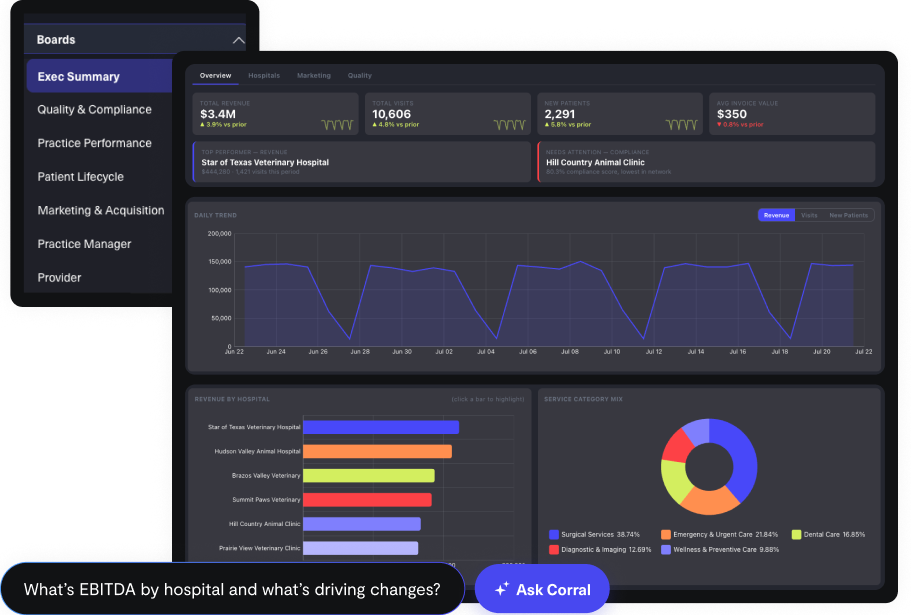
CorralData's conversational AI assistant that lets business users ask questions about their data in plain English and receive instant answers, visualizations, and recommendations — no SQL or technical skills required.
Attribution Modeling
A framework for assigning credit to marketing touchpoints along the customer journey. Attribution models help businesses understand which channels, campaigns, and content drive conversions and revenue.
Audit Trail
A record of who accessed what data and when. Audit trails are essential for HIPAA compliance and for troubleshooting when a number changes unexpectedly.
Automated Reporting
The process of using software to generate, format, and distribute business reports on a recurring schedule without manual intervention. Automated reporting eliminates hours of repetitive work and ensures stakeholders receive timely, consistent data.
BAA (Business Associate Agreement)
A legally binding contract required under HIPAA between a covered entity (like a healthcare provider) and a business associate (like a data platform) that handles protected health information (PHI). CorralData signs BAAs with all healthcare customers. Learn about CorralData security.
Backup
A restorable snapshot of a database, taken so data can be recovered after loss or corruption. Backups differ from replicas, which stay continuously synchronized rather than existing as a point-in-time copy.
Blended ROAS
A metric that measures total revenue generated divided by total marketing spend across all channels. Unlike channel-specific ROAS, blended ROAS gives a holistic view of overall marketing efficiency.
Business Associate
A vendor that creates, receives, or handles protected health information (PHI) on behalf of a covered entity, such as a healthcare provider. HIPAA requires a signed BAA between the two before any PHI can be shared.
Business Intelligence (BI)
The technologies, practices, and strategies used to collect, integrate, analyze, and present business data. BI tools help organizations make informed decisions by transforming raw data into meaningful insights through dashboards, reports, and visualizations.
CASE
SQL’s version of if/then/else logic, used to bucket, label, or reclassify values within a query. It’s how a query can turn raw values like state codes into readable categories such as ‘West’ or ‘East’ on the fly.
CDC (Change Data Capture)
A technique for reading a database’s internal change log to capture every insert, update, and delete as it happens, rather than repeatedly re-querying the whole table. It’s what allows a data pipeline to stay near real-time without overwhelming the source system.
Cloud Data Warehouse
A managed, cloud-hosted database optimized for analytical queries and reporting. Unlike traditional databases designed for transactions, cloud data warehouses are built to process large volumes of data quickly for business intelligence and analytics.
Cohort Analysis
A method of analyzing user behavior by grouping customers into cohorts based on shared characteristics or time-based events (e.g., signup month, first purchase date). Cohort analysis helps identify trends in retention, revenue, and engagement over time.
Column
One kind of information stored in a table, such as first_name or amount_paid. Every row in the table has a value (or a blank) for each column.
Columnar Storage
A storage method that keeps each column’s values together on disk instead of storing each row as one block. It’s the main reason modern data warehouses can scan millions of rows and answer big analytical questions quickly.
Conversational Analytics
An approach to data analysis that allows users to interact with data through natural language questions and answers, similar to chatting with a knowledgeable colleague. Instead of writing SQL queries or building reports, users simply ask questions in plain English.
Covered Entity
A healthcare provider, health plan, or healthcare clearinghouse directly regulated by HIPAA. Covered entities must sign a BAA with any business associate that handles PHI on their behalf.
CTE (Common Table Expression)
A named, reusable building block inside a SQL query, defined once and referenced later in the same query. CTEs let complex logic be broken into readable steps instead of one dense, nested statement.
Customer Acquisition Cost (CAC)
The total cost of acquiring a new customer, calculated by dividing total sales and marketing expenses by the number of new customers acquired in a given period. CAC is a critical metric for evaluating marketing efficiency and business sustainability.
Customer Lifetime Value (CLV/LTV)
A prediction of the total revenue a business can expect from a single customer over the entire duration of their relationship. CLV helps businesses understand how much to invest in acquiring and retaining customers.
Dashboard
A visual interface that displays key business metrics and data points in real time. Dashboards consolidate data from multiple sources into a single view, making it easy for stakeholders to monitor performance and identify trends at a glance.
Data Connector
A pre-built integration that pulls data from a specific source (like Shopify, Google Ads, or Zenoti) into a data platform or warehouse. Data connectors automate data ingestion, eliminating manual exports and ensuring data stays fresh.
Data Integration
The process of combining data from multiple sources into a unified view. Data integration involves extracting data from different systems, transforming it into a consistent format, and loading it into a central repository for analysis.
Data Lake
Low-cost, flexible storage for raw files in their original format, before they’ve been cleaned or modeled. A lakehouse combines a data lake’s cheap storage with a data warehouse’s structure and query performance.
Data Modeling
The process of reshaping raw source records into clean, business-friendly tables that reflect how the organization actually thinks about its data. It’s where metric definitions get made explicit, rather than left to whoever happens to write a query.
Data Pipeline
An automated sequence of steps that moves data from source systems through transformation processes into a destination like a data warehouse. Data pipelines ensure data flows reliably and consistently without manual intervention.
Data Warehouse
A centralized repository that stores structured data from multiple sources, optimized for analytical queries and reporting. Data warehouses enable organizations to run complex queries across all their business data without impacting operational systems.
De-Identification
The process of stripping identifying details from a dataset so it no longer counts as protected health information (PHI) under HIPAA. Properly de-identified data can be used more freely for analysis without the same regulatory restrictions.
Definition Mismatch
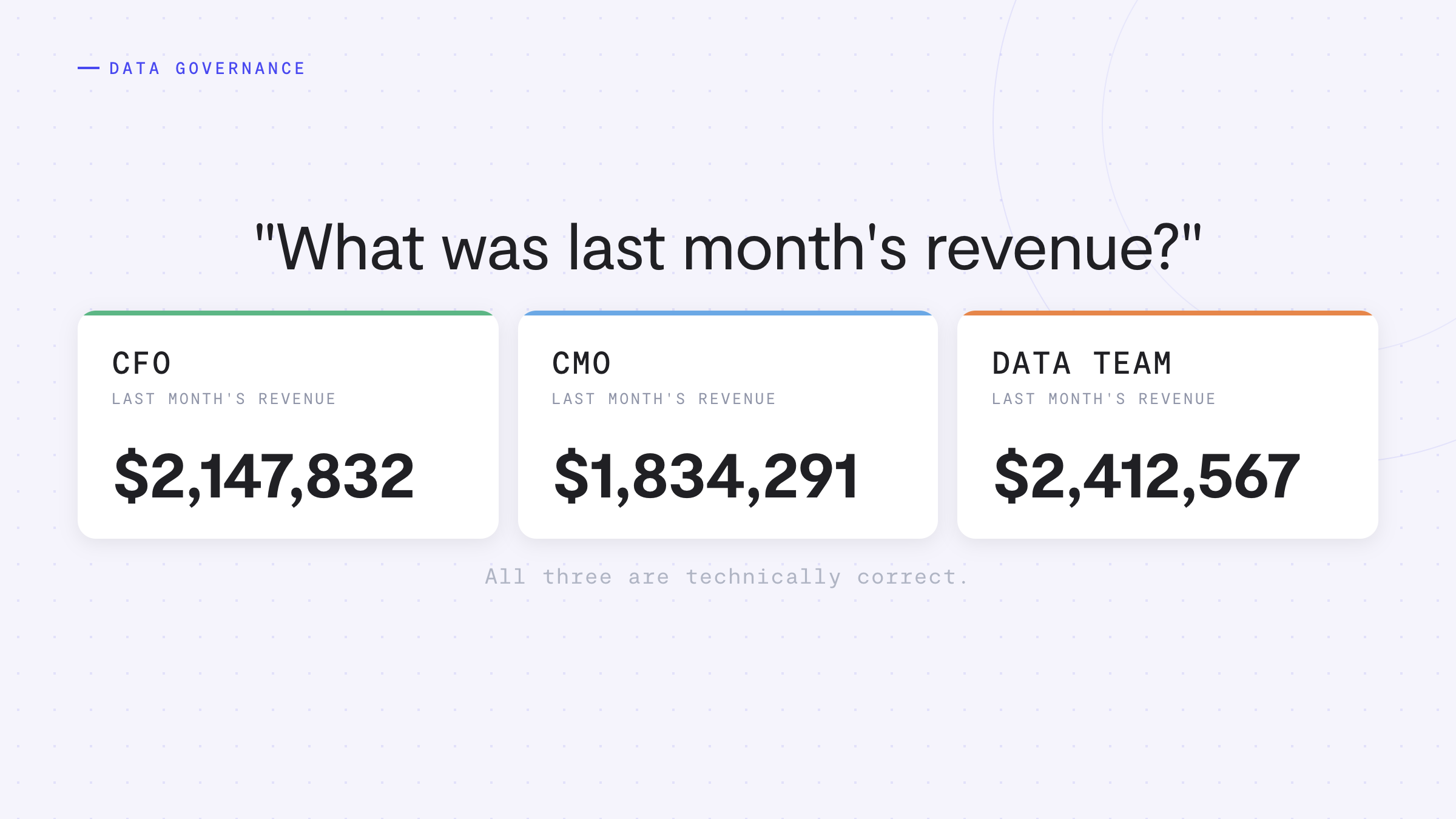
When two reports count a same-named metric differently — one includes refunds, one doesn’t; one counts unique visits, one counts total visits. It’s the most common reason two ‘correct’ reports show different numbers for something with the same name.
Dimension
A table of descriptive context in a data model, such as guests, services, locations, or dates. Dimensions answer the ‘who, what, where, when’ questions that give a fact table’s numbers meaning.
ELT (Extract, Load, Transform)
A modern data integration approach where raw data is extracted from sources and loaded directly into a data warehouse before being transformed. ELT takes advantage of the processing power of cloud data warehouses to handle transformations.
EMR (Electronic Medical Record)
A digital version of a patient's medical chart used by healthcare providers to store clinical data. EMR systems like Zenoti, NexTech, and ModMed are critical data sources for healthcare analytics.
Encryption in Transit / At Rest
Encryption in transit protects data while it moves between systems, typically via HTTPS; encryption at rest protects data where it’s stored, using encrypted disks or databases. HIPAA-compliant platforms are expected to apply both.
ETL (Extract, Transform, Load)
A traditional data integration process that extracts data from source systems, transforms it into a usable format, and loads it into a destination system like a data warehouse. ETL is fundamental to building a reliable analytics infrastructure.
Fact
A table of measurable events in a data model, such as appointments, payments, or invoice lines. Fact tables hold the numbers; dimension tables hold the context around them.
Fanout
A join that unexpectedly matches more than one row on the other side, duplicating records and inflating totals. Fanout is a common, quiet cause of numbers that look too high without any obviously wrong data.
Field
A single value at the intersection of one row and one column — for example, the amount_paid value for one specific invoice. ‘Field’ and ‘column’ are often used interchangeably.
Foreign Key
A column in one table that points to another table’s primary key, linking the two together. Foreign keys are what let a database join a payment record to the guest who made it.
Full / Incremental Load
A full load re-copies an entire dataset from source to destination; an incremental load copies only what has changed since the last sync. Incremental loading is the everyday mode for most data pipelines, since it’s far faster and lighter on the source system.
Grounding
Anchoring an AI’s answers in authoritative, governed sources — modeled tables, canonical metric definitions — instead of letting it improvise from general knowledge. Grounding is the primary defense against hallucination in AI analytics tools.
Hallucination
A fluent, confident, and factually wrong answer generated by an AI. In analytics, hallucination is contained by requiring that every answer trace back to a real, visible query against governed data, not the model’s own guess.
HIPAA (Health Insurance Portability and Accountability Act)
A US federal law that establishes standards for protecting sensitive patient health information. Any organization handling protected health information (PHI) must ensure HIPAA-compliant security controls including encryption, access controls, and audit logging. Learn about CorralData's HIPAA compliance.
HTTPS
The encrypted connection standard used across the modern web. It’s what makes API traffic unreadable to anyone intercepting it in transit.
Index
A database structure that speeds up lookups, similar to a book’s index pointing to a page number instead of forcing a reader to scan every page. A well-placed index is often the difference between a query that returns instantly and one that crawls.
Join
The SQL operation that stitches two or more tables together based on a shared key, such as a foreign key. An inner join keeps only rows that match in both tables; a left join keeps every row from the first table regardless of a match.
KPI (Key Performance Indicator)
A measurable value that demonstrates how effectively an organization is achieving its key business objectives. KPIs vary by industry and department — examples include revenue growth rate, patient retention rate, and customer acquisition cost.
Latest-State
A data storage pattern that keeps only the current version of each record, overwriting the previous value when something changes. It’s the opposite of an append-only model, which preserves every historical version.
LLM (Large Language Model)
An AI model trained on massive amounts of text, capable of understanding questions and generating answers, code, and even SQL. LLMs are the underlying technology behind conversational AI analytics tools like AskCorral.
Looker
A business intelligence platform owned by Google that uses a proprietary modeling language called LookML. Looker requires significant technical expertise to set up and maintain, making it better suited for organizations with dedicated data teams.
LTV:CAC Ratio
A metric that compares Customer Lifetime Value to Customer Acquisition Cost. The LTV:CAC ratio indicates the return on investment for acquiring customers — a ratio of 3:1 or higher is generally considered healthy for sustainable growth.
Marketing Mix Modeling (MMM)
A statistical analysis technique that measures the impact of various marketing tactics on sales and other business outcomes. MMM helps allocate marketing budgets by quantifying the ROI of each channel in the marketing mix.
MedSpa Analytics
Specialized data analysis for medical spas and aesthetic practices, covering metrics like treatment profitability, provider performance, patient retention, and marketing ROI across systems like Zenoti, NexTech, and ModMed. Learn about MedSpa reporting.
Metric Drift
The same metric defined differently across different reports or teams, without anyone deciding to change it. Metric drift isn’t a data quality problem so much as an unmade decision — nobody picked one definition and enforced it everywhere.
Minimum Necessary
HIPAA’s operating principle that any use or disclosure of PHI should be limited to the least amount needed to accomplish the task at hand. It’s the standard that role-based access and row-level security are built to enforce.
Natural Language Processing (NLP)
A branch of artificial intelligence that enables computers to understand, interpret, and respond to human language. In analytics, NLP powers conversational interfaces that let users ask data questions in plain English instead of writing SQL.
No-Code Analytics
Analytics platforms and tools that allow business users to build reports, dashboards, and data analyses without writing code. No-code analytics democratizes data access by removing technical barriers to insight.
OAuth
An open standard authorization protocol that allows third-party services to access user data without exposing passwords. OAuth is the secure authentication method used by most modern data connectors to link platforms like Google Ads, Shopify, and HubSpot.
OLAP (Online Analytical Processing)
The database family built to answer big, complex analytical questions across large volumes of historical data. A data warehouse is a classic OLAP system.
OLTP (Online Transaction Processing)
The database family built to run the day-to-day operations of a business, recording individual transactions quickly and reliably. An EMR or point-of-sale system is a classic OLTP system, optimized for writing one record at a time rather than analyzing millions at once.
Operational Analytics
The practice of using data analysis to monitor and improve day-to-day business operations in real time. Operational analytics focuses on actionable metrics that drive immediate decisions, like staffing levels, inventory, and appointment scheduling.
Pagination
The practice of APIs serving large datasets in smaller pages rather than all at once, one request at a time. It’s a major reason why a first-time data sync can take hours instead of minutes.
Patient Acquisition Cost
The total marketing and operational cost of acquiring a new patient, calculated by dividing total acquisition spend by the number of new patients in a given period. This is a critical metric for MedSpas and healthcare practices evaluating marketing ROI.
PHI (Protected Health Information)
Any individually identifiable health information held or transmitted by a covered entity or business associate. PHI includes names, dates, medical records, and billing information — all of which require HIPAA-compliant handling.
PII (Personally Identifiable Information)
Any piece of information that can identify a specific person, such as a name, email address, phone number, or birth date. PII is a broader category than PHI, which specifically covers health-related identifiers.
Predictive Analytics
The use of statistical algorithms, machine learning, and historical data to forecast future outcomes. Predictive analytics helps businesses anticipate trends like customer churn, demand fluctuations, and revenue projections.
Primary Key
The column, or combination of columns, that uniquely identifies each row in a table. No two rows in a well-formed table share the same primary key value.
Provenance
The ability to trace exactly where an answer came from — the query that ran, the definitions it used, the source data behind it. Provenance is what turns ‘trust me’ into something a business leader can actually verify.
Provider Performance Metrics
Key measurements used to evaluate individual service providers (doctors, aestheticians, therapists) based on revenue generated, patient satisfaction, retention rates, rebooking rates, and average treatment value.
Rate Limit
A cap on how many requests an API will accept in a given time period. Rate limits protect operational systems from being overwhelmed by data pulls, which is why pipelines are built to work within them.
RBAC (Role-Based Access Control)
A security approach that restricts data and system access based on a user's role within an organization. RBAC ensures that team members only see the data relevant to their responsibilities — essential for compliance and data governance. Learn about CorralData security.
Relational Database
A database whose tables are connected to one another through keys, allowing information to be split across tables and joined back together as needed. Virtually every business system — EMR, CRM, POS — is built on a relational database.
Replica
A live, continuously synchronized copy of a database, kept either for safety or so heavy reporting queries don’t slow down the main operational system. Unlike a backup, a replica stays current in near real time.
Reverse ETL
The process of syncing transformed data from a data warehouse back into operational tools like CRMs, email platforms, and ad networks. Reverse ETL activates analytical insights by pushing segments, scores, and metrics into the systems where teams work. Learn about CorralData's Reverse ETL.
ROAS (Return on Ad Spend)
A marketing metric that measures revenue generated for every dollar spent on advertising. ROAS is calculated by dividing revenue attributed to ads by the cost of those ads. A ROAS of 4:1 means $4 in revenue for every $1 spent.
Row
One record in a table — one guest, one appointment, one invoice. A row is read across all of the table’s columns.
Row-Level Security
Limits on which specific records a user can see, layered on top of role-based permissions — two people with the same role can still see different rows if row-level security is applied. It enforces HIPAA’s minimum necessary standard automatically, instead of relying on manual redaction.
Schema
The blueprint of a database: which tables exist, what columns each one has, and how they relate. Understanding a schema is usually the first step in writing a correct query.
Schema on Read
A data architecture approach where raw data is stored as-is and structure is applied only when the data is queried. This contrasts with schema on write, where data must be structured before storage. Schema on read offers flexibility for exploratory analytics.
Self-Service Analytics
An approach to business intelligence that empowers non-technical users to access, analyze, and visualize data independently without relying on IT or data teams. Self-service analytics tools prioritize ease of use and guided exploration.
Semantic Layer
The single governed place where each metric is defined once, canonically, so every report and every AI answer pulls from the same definition. It’s the structural fix for metric drift, rather than a rule everyone has to remember to follow.
Single Source of Truth (SSOT)
A centralized data repository where all business data from various sources is unified, deduplicated, and standardized. An SSOT ensures everyone in the organization is making decisions based on the same consistent, accurate data.
SOC 2 Compliance
A security framework developed by the American Institute of CPAs (AICPA) that verifies a service provider securely manages data to protect the interests and privacy of its clients. SOC 2 audits evaluate controls related to security, availability, processing integrity, confidentiality, and privacy. Learn about CorralData's SOC 2 compliance.
SQL (Structured Query Language)
A programming language used to manage and query relational databases. While SQL is powerful for data analysis, it creates a bottleneck when only technical team members can write queries — conversational analytics tools like AskCorral eliminate this barrier.
Stale vs. Wrong
The first troubleshooting fork for a number that looks off: is the data stale (not yet refreshed) or actually wrong (an error in the pipeline or definition)? The two problems have very different fixes, so diagnosing which one you’re facing comes first.
Star Schema
A data modeling pattern used in data warehouses that organizes data into fact tables (containing measurements) surrounded by dimension tables (containing descriptive attributes). Star schemas optimize query performance for analytical workloads.
Sync Frequency / Latency
Sync frequency is how often a data source refreshes into the warehouse; latency is the total delay between something happening in the source system and it appearing on a dashboard. Both determine how ‘live’ a dashboard really is.
Table
A grid of rows and columns holding one kind of thing, like guests, appointments, or transactions. Tables are the basic unit of storage in a relational database.
Tableau
A widely-used business intelligence platform known for its data visualization capabilities. While powerful, Tableau typically requires technical expertise for data preparation and modeling, and does not include built-in data integration or warehousing.
Text-to-SQL
The capability of translating a plain-English question into a working database query. It’s what lets a business user type a question in normal language while the AI writes the SQL and the warehouse supplies the answer.
Timezone Drift
Transactions appearing to land on the ‘wrong’ day because systems store time in a universal format (like UTC) while people think in local time. It’s a common, quiet source of numbers that don’t match between two reports covering ‘the same day.’
Treatment Profitability
A healthcare analytics metric that calculates the net profit margin for specific medical treatments or services by factoring in revenue, supply costs, labor time, and overhead. Treatment profitability analysis helps practices optimize their service mix.
Uptime
The percentage of time a system is available and operating normally. 99.9% uptime, sometimes called ‘three nines,’ allows for less than nine hours of downtime per year.
Window Function
A SQL capability that computes running totals, visit numbers, or period-over-period changes without collapsing the underlying rows the way a standard aggregation would. It’s how a report can show both the individual transactions and a running total in the same result.
Zenoti
A cloud-based practice management and EMR platform designed for MedSpas, salons, and wellness businesses. Zenoti manages appointments, billing, inventory, and patient records — making it a critical data source for MedSpa analytics and reporting.


Experience the power of actionable intelligence
Make your data work for you. Book a demo today to see CorralData in action.