



 " alt="">

















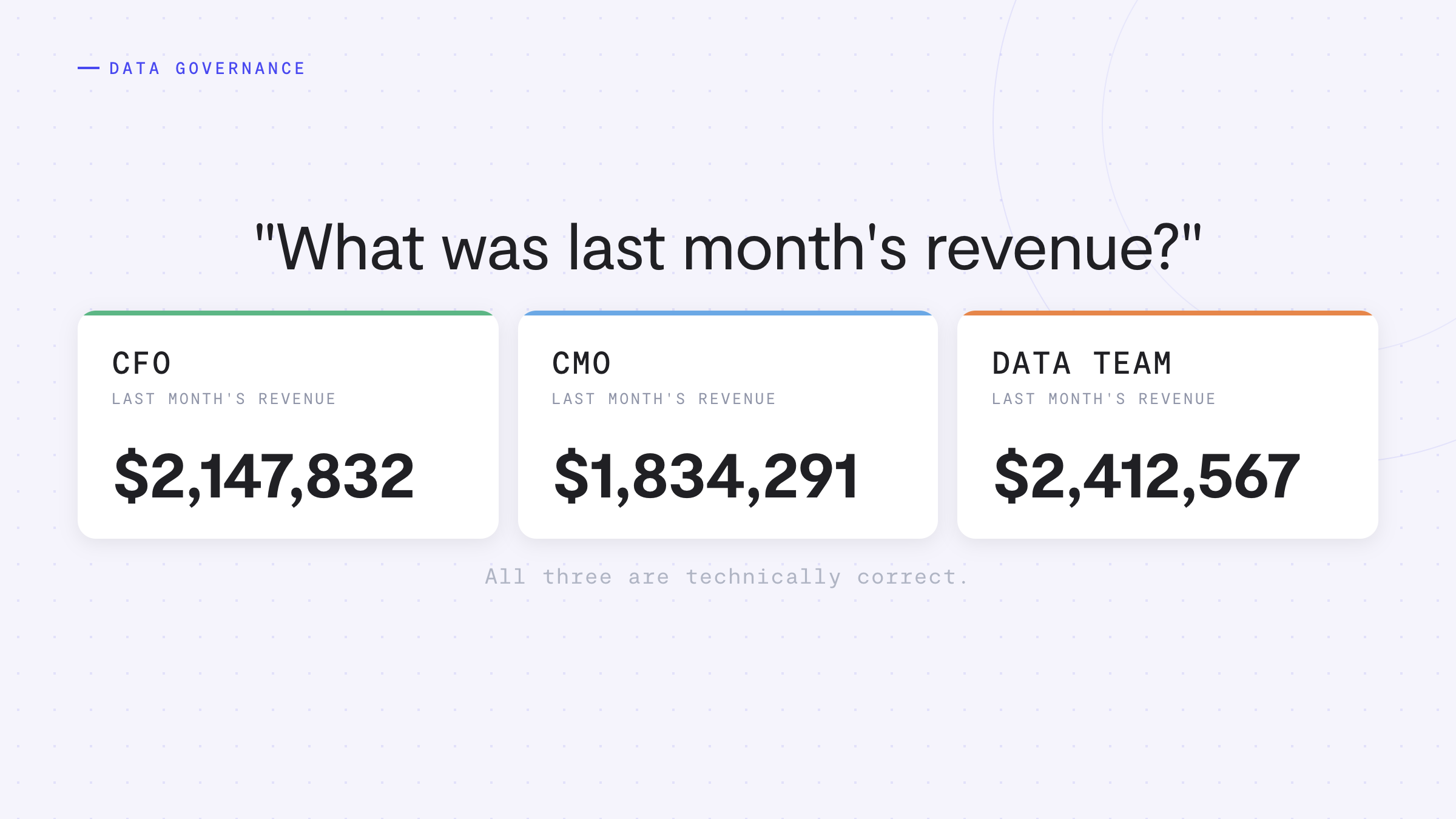
The CFO walks into a meeting with one revenue number. The CMO has a different one. The data team, asked to adjudicate, produces a third. All three are technically defensible. All three came from real data. None of them are obviously wrong. That's exactly the problem.
This scenario plays out in organizations at every stage of data maturity. The cause could be any number of things, and often several at once: conflicting definitions, inconsistent source data, or a freshness gap between what one team sees and what another does. For heads of data and CIOs, this is the job in its most frustrating form: not building things, but explaining why things disagree. Reconciling numbers that should never have diverged. Rebuilding trust in data that was never actually broken.
The fix isn't a data audit or a documentation sprint. It's a governed data stack: one where definitions are codified, accuracy is verifiable at every layer, and the same question reliably produces the same answer regardless of who or what is asking it.
What governance actually means: When most people hear "data governance," they think access control: who's allowed to see what, permissions, compliance. That's part of it, but it's the smallest part. Data governance is the system of policies, definitions, standards, and accountability structures that ensure data is accurate, consistent, and trustworthy across an organization. In practice, it governs things like: what does "active customer" mean, and who decides? Are analysts building from approved definitions, or writing their own interpretations? And when a business definition changes, who's responsible for updating every system that depends on it?
The same question. Different answers. Here's why.
The question: "what's last month's revenue?" Trace the query through every layer to see where accuracy is won or lost, and how a governed stack changes the outcome. Click Trace the query to start.
This is illustrative of where accuracy is won and lost across a data stack. Architectures and failure modes vary.
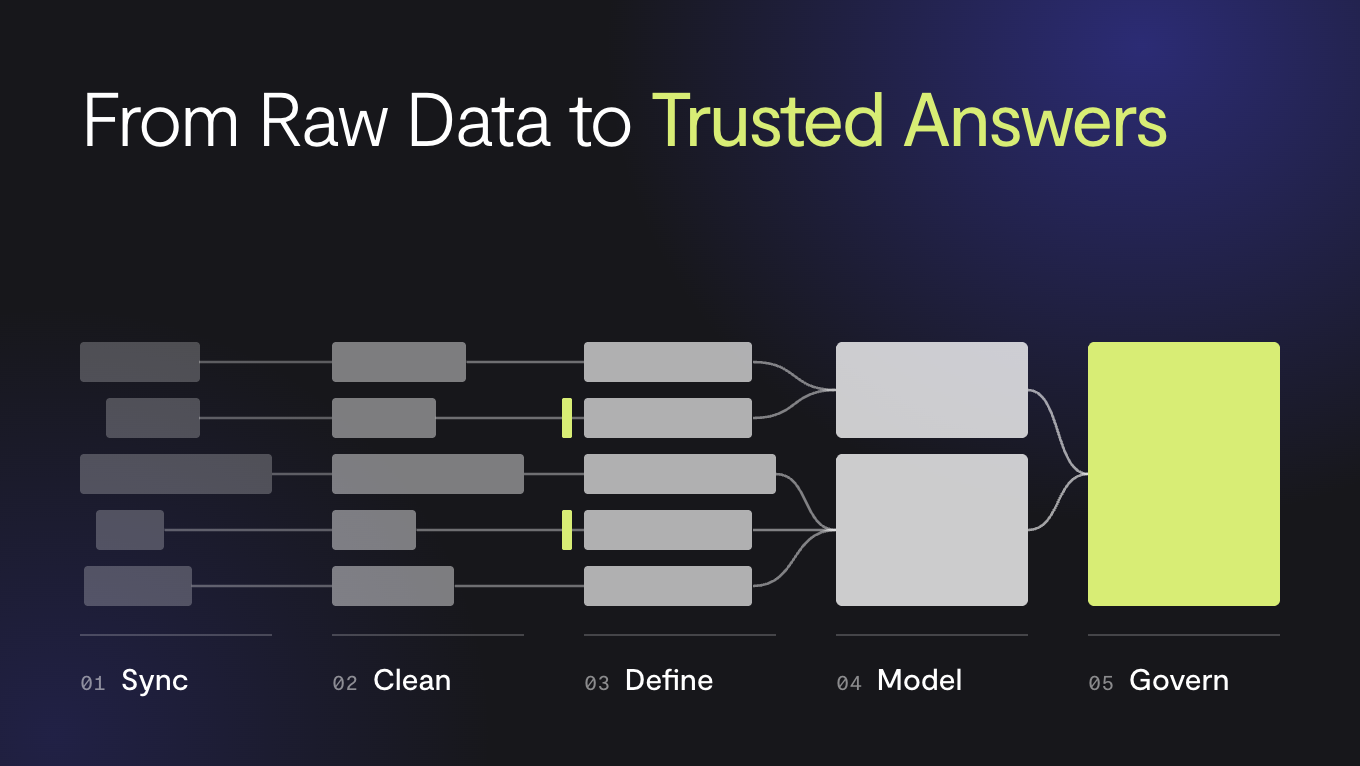
Governance isn't a layer you add on top of a data stack. It runs through the entire thing, from how data enters the organization to how it reaches a decision.
Ungoverned stacks accumulate error.
When metric definitions live inside individual SQL queries, every query is an inference, a reasonable interpretation of what the number should mean. Multiply that across every analyst, every dashboard, and every AI query, and the same question produces different answers depending on who or what generated it. Probabilistic systems don't fail loudly; they drift.
Governed stacks produce consistent, traceable answers.
When a metric is codified in the semantic layer and SQL is generated from that definition, the answer is the same every time, because the definition is unambiguous. Three teams can legitimately get different revenue numbers. The difference is whether those differences are intentional, named, and governed, or invisible and compounding.
AI agents make this urgent. The degree of probabilism in an AI's outputs is a direct function of how much of the underlying stack is ungoverned.
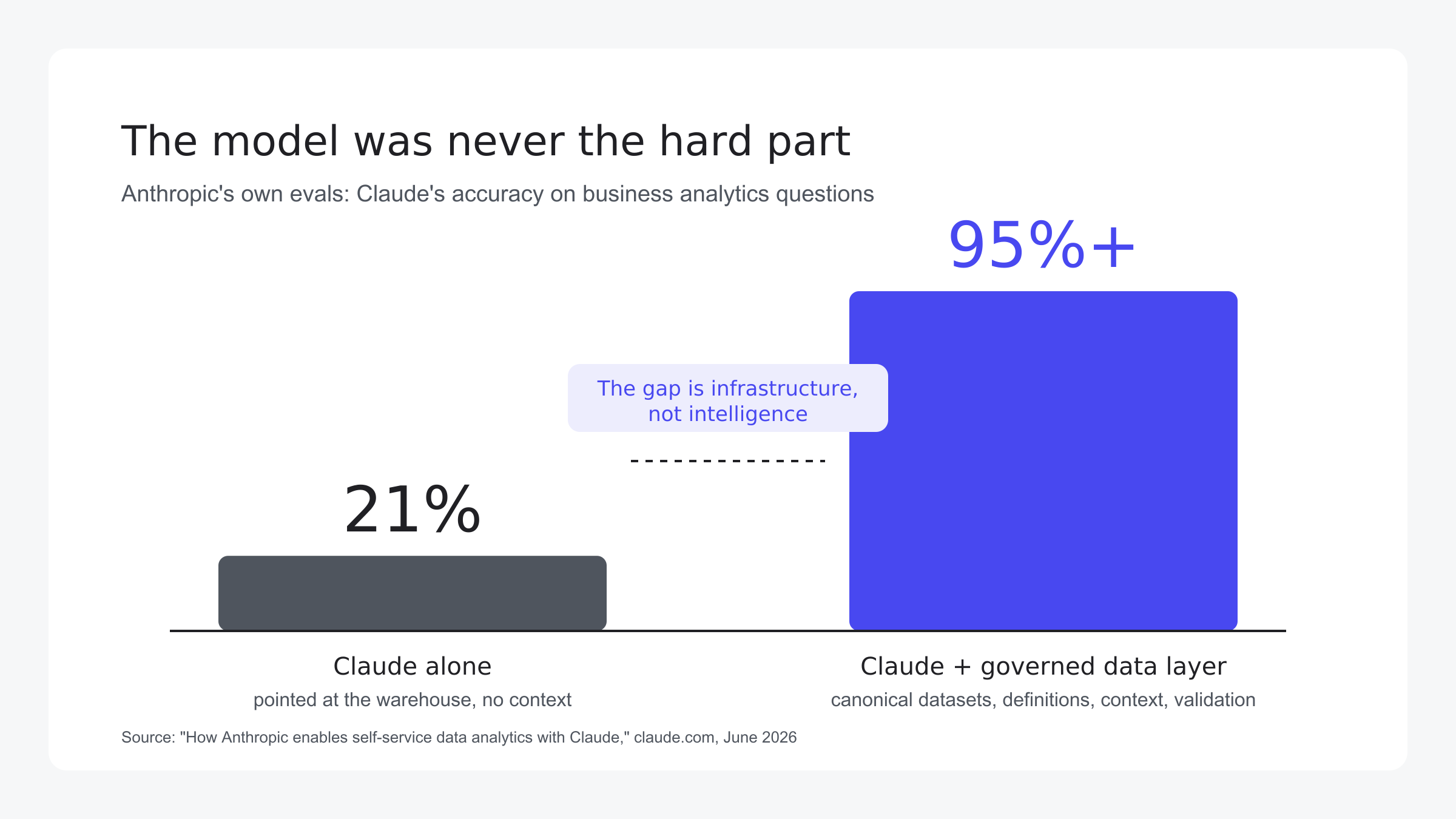
Anthropic published their internal numbers in June 2026: Claude alone scored 21% accuracy on their own analytics evals, rising to 95%+ only with a governed stack underneath (we published a deeper look at the numbers here). Governance that was adequate for five analysts writing queries manually will not hold when an AI is generating hundreds of queries per day against the same ungoverned definitions.
What governance requires at every layer
Source systems (EMRs, CRMs, billing tools, ad networks, POS platforms) generate data as a byproduct of running operations. They weren't built to answer business questions; they were built to manage workflows. Different sources have fundamentally different sync cadences: some push data in real time as events occur, others export in nightly batches. That cadence defines the freshness ceiling for any downstream analysis touching that source.
Governance at this layer means understanding exactly what each source produces, how reliably it produces it, and what "current" means for that system at any given point. The moment you need a metric the source doesn't natively produce (churn rate, LTV, rebooking rate) you're entering the territory of the pipeline and transformation layers, where most accuracy problems originate.
Treating all source systems as equivalent. A metric combining a real-time source and a daily batch export has a freshness ceiling defined by the slower of the two. Most dashboards don't surface that, so teams assume data is current when the underlying source hasn't updated in hours. Assuming source systems are the authority on business metrics is the second failure: a scheduling platform records appointments; it doesn't know whether a patient is trending toward churn.
Data moves from source systems into the warehouse via ELT pipelines (tools like Fivetran or Airbyte extract from each source, load raw data into the warehouse, and leave transformation to happen there). Pipelines run on schedules: hourly, nightly, or event-triggered.
Good governance requires that pipelines be observable, covering not just whether they ran, but how long they took, how many records loaded, whether that matches expected record counts, and whether there were schema errors. This is sync health: the operational visibility layer that answers a prerequisite question before any analysis runs: is the data actually current and complete? Governance also requires that schema changes in source systems (renamed columns, changed data types, deprecated tables) are caught and reconciled at the ingestion layer before they propagate as silent errors downstream.
Incremental syncs that miss historical updates. Most ELT pipelines are designed to capture new records: they run on a schedule, pick up what's changed since the last sync, and stop there. When a historical record gets corrected or updated at the source (a retroactive billing adjustment, a patient record merge) the incremental sync often never sees it. The pipeline runs successfully, record counts look right, and the warehouse holds a version of history that no longer matches the source, with nothing to flag it.
Raw ingested data is cleaned and made structurally usable: deduplication, field name standardization across sources, type enforcement, null handling. Then data modeling takes over: business logic that doesn't exist in any source system gets encoded here. Derived metrics like cohort retention, patient LTV, rebooking rates, and net revenue after returns are calculated and encoded as reusable models (commonly in dbt). Models define the join logic that connects data across sources and produce the numbers organizations actually use to make decisions.
Good governance treats models as living definitions, not static builds. When business logic changes (a new attribution methodology, a revised definition of "active," a change in the rebooking window) the model changes with it, and that change propagates downstream automatically. Model ownership must be explicit: someone is accountable for whether a model's logic reflects current business intent, not just whether it runs without errors.
A model that produces the right aggregate but is wrong at the detail level. Bad join logic, particularly many-to-many relationships that introduce row duplication, can inflate or misattribute data in ways that look correct at a rolled-up total but fall apart the moment you drill down to customer, region, or product line. Because the top-line number passed a sanity check, nobody looks further. Inconsistent transformation rules across sources is the second failure: two systems may represent a cancelled appointment differently. If transformation handles each independently without reconciling those conventions, the downstream model inherits the inconsistency silently.
Where data modeling produces the data, the semantic layer assigns it meaning: what counts as revenue, what the correct attribution window is, how churn is calculated, which records qualify as "active." These definitions are what every downstream query should reference. The semantic layer doesn't produce data; it produces meaning.
The most important governance principle applies here: a metric's definition should describe what it means in business terms, not how to calculate it. SQL is generated from that definition, not the other way around. Most data stacks operate in reverse: metric definitions live inside individual SQL queries, written by analysts who each made their own reasonable interpretation. The result is a probabilistic system where the same question produces different answers depending on who authored the query. Each codified definition becomes a canonical, owned, authoritative metric, and its provenance is traceable back through the definition to the source data underneath.
The semantic layer also handles the legitimate reality that many organizations have multiple valid definitions of the same term. Marketing's revenue and finance's revenue are often deliberately different. The answer isn't to collapse them; it's to codify each separately, named and governed: "revenue (gross, marketing attribution)" vs. "revenue (recognized, GAAP)." The choice of which definition to use becomes an explicit, auditable decision rather than an assumption embedded in a query.
Definitions that exist only inside SQL, meaning every query is an interpretation with no authoritative source to resolve disagreements. Pull the SQL from three revenue dashboards built by different analysts at different times and you'll find three different implementations: different date filters, different handling of refunds, different treatment of intercompany transactions. All defensible, all different. The second failure: assuming you can reconstruct a canonical definition by reverse-engineering how queries have historically been written. That's still probabilistic inference, getting the right answer most of the time with no mechanism for knowing when it doesn't.
The output of a data model can be persisted as its own table in the warehouse (materialized) or computed dynamically each time it's queried. Materialization is a performance decision: querying a cached result is significantly faster than rerunning model logic across large datasets on every request. The tradeoff is freshness: a materialized table is a snapshot, static until explicitly refreshed on its schedule.
Good governance requires that materialization cadence be an explicit, documented decision matched to the freshness requirements of actual downstream users, not a default set once during initial setup and never revisited. Finance needing data current as of this morning has different requirements than a weekly executive report. Materialization jobs should be part of sync health monitoring: if a refresh fails or runs significantly late, that needs to surface before users query against stale data.
Dashboards and queries serving cached results that users assume are live. A finance report that looks real-time but is running against a materialization from the previous morning, set to refresh nightly during initial setup and never revisited as Finance's needs changed. The failure isn't in the data. It's in the mismatch between actual and assumed freshness, invisible to anyone who doesn't know the materialization schedule. Monitoring that doesn't include materialization jobs creates the same gap: ingestion ran, transformation ran, but the materialized table the dashboard queries hasn't refreshed yet.
Dashboards, reports, and ad hoc queries translate modeled data into what stakeholders actually see. Queries should reference governed datasets and governed metrics, not raw source tables. When a visualization is built on governed foundations (a governed dataset, a governed metric, a query generated from a canonical definition rather than authored from scratch) the result is a governed widget: one that produces a consistent answer because it draws from a consistent definition. Two governed widgets referencing the same metric produce the same number, without approximation. Freshness timestamps should be surfaced alongside every number so users know what "current" means for what they're looking at.
Queries written directly against raw source tables, bypassing governed datasets entirely. Duplicate metric definitions scattered across dozens of widgets, each with slightly different logic for handling refunds or date ranges. Ungoverned editing: in most BI environments, any analyst with access can modify a shared dashboard, meaning the carefully reviewed query from last quarter may have been silently changed by someone who didn't understand what it was doing, with no audit trail and no downstream notification.
AI agents accept natural language questions and generate queries against the underlying data at higher volume and with significantly less oversight than a human analyst. They represent a new participant at the visualization layer, one that can query hundreds of times per day without anyone reviewing individual outputs. Their accuracy is entirely dependent on the quality of the infrastructure they sit on top of.
An AI querying against ungoverned data does what it has to: it infers definitions from available evidence (existing queries, column names, historical patterns). That inference is probabilistic. It's right most of the time, with no reliable mechanism for knowing when it isn't. An AI operating on a fully governed foundation operates differently: it executes against fixed, canonical definitions rather than inferring them. The same question produces the same answer not because the model happened to make the same inference twice, but because the definition is codified and the query is generated from it.
The degree of probabilism in an AI's outputs is a direct function of how much of the underlying stack is ungoverned. Each ungoverned layer (inference on definitions, business logic, table relationships) compounds the others. Governance that was adequate for five analysts writing queries manually may not hold when an AI is generating hundreds of queries per day against the same foundation.
Using an AI agent as a substitute for a governed data foundation. The model can compensate for some governance gaps through inference, but inference is not governance, and there is no reliable way to know when the inference is wrong. The right model is governance first, AI on top, not AI as a workaround for missing governance.
Five questions to ask any AI analytics vendor (including us)
- Where do canonical definitions live, and who maintains them?
If the answer is "the model figures it out," you've recreated the 21% scenario. - What happens when the schema changes?
If context isn't updated alongside data, accuracy is already decaying. - How is accuracy measured?
If there's no eval process, nobody knows the error rate — including the vendor. - Is this set-it-and-forget-it?
Any honest answer involves ongoing monitoring, human review, and a mechanism for surfacing drift before it compounds. - Can you see where an answer came from?
Provenance is the difference between trusting a number and forwarding a mistake to your board.
We build and operate the governed stack for you.
CorralData isn't a tool you buy and configure on your own. Your data is always yours, we build the infrastructure around it for you, governed by default. With it in place, CorralData's AI can detect, analyze, recommend, and act: not just surfacing what happened, but recommending what to do next and acting on it, answering questions against governed definitions, flagging anomalies before they reach a decision, and writing back to the tools your business runs on.
That's what becomes possible when the data foundation underneath is built right. The accuracy problems on this page aren't edge cases — they're the default state of many organizations. We can fix that for yours, book a demo to see your data in action.