




 " alt="">

















Data governance
Trust your data.
Right now, trusting a number means knowing who to ask. That person takes a vacation, or leaves, and the answer leaves with them. Governance moves the answer out of someone's head and into the platform.
Sound familiar?
Three signs your data isn't governed
None of these are anyone's fault. They're what happens when the meaning of a number lives inside individual queries instead of in one place.
Numbers that don't match from report to report
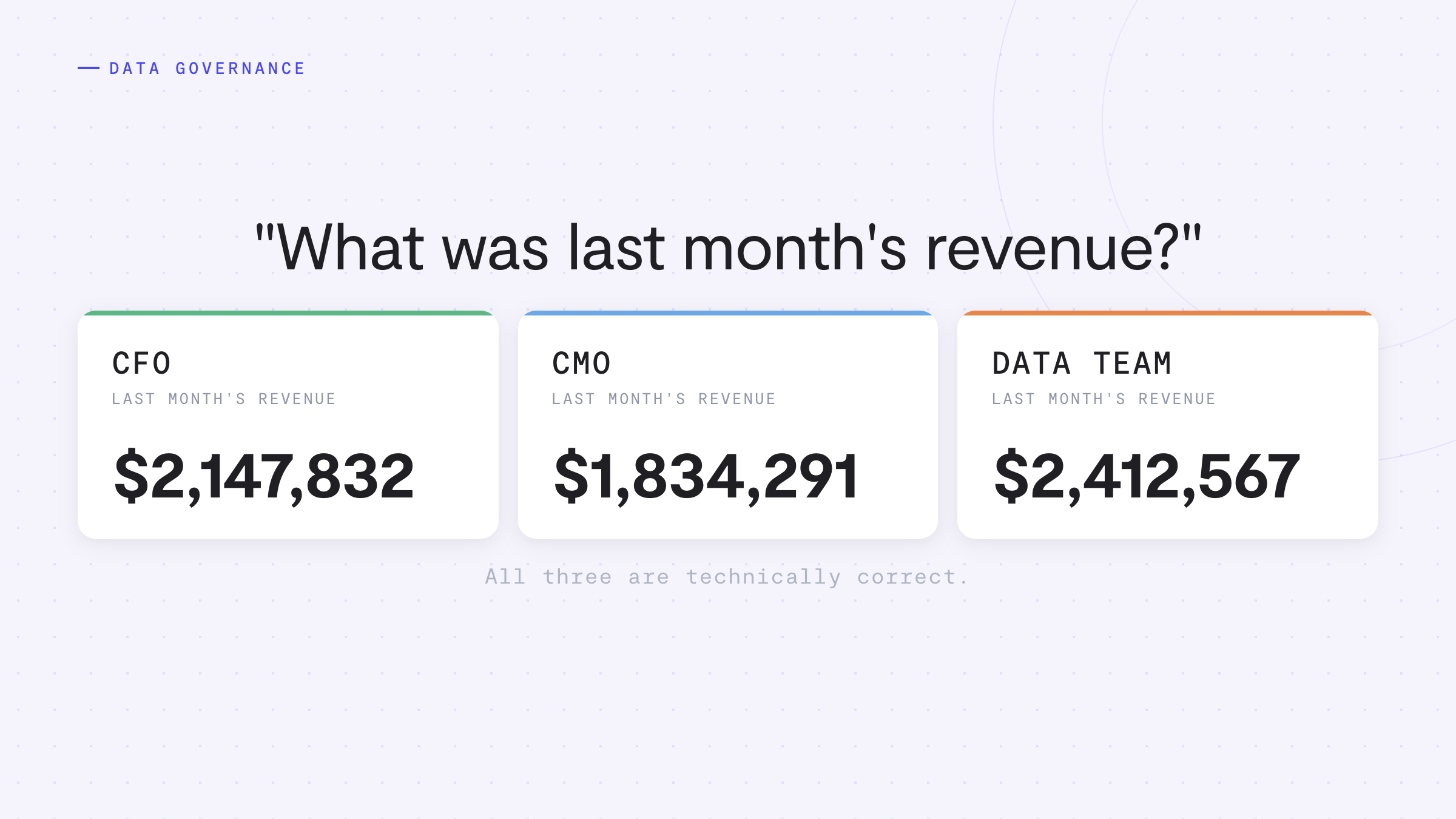
Finance has one revenue figure, the location report has another, the monthly pack has a third. All three are defensible, and somebody still spends Monday working out which one goes in front of the board.
AI that answers confidently and wrongly
Ask an AI tool a question when three systems define “patient” differently and it picks one, or blends them, and sounds certain either way. If a new hire can't tell which revenue number is right, an AI agent can't either.
A metric that changes meaning depending on who built the report
“Active patient” gets defined inside whichever query needed it that week. Nobody wrote it down, nobody owns it, and it drifts every time someone builds something new.
From people-oriented to system-oriented
Data trust used to live in people. You knew whose numbers to believe and which reports to double-check. That stops working the moment the team grows or a location gets acquired.
- Means
- Collected service and product revenue, less refunds and discounts. Gift cards count when redeemed, not when sold.
- Reads
- Zenoti invoices · QuickBooks journal
One definition, from the data model to the AI answer
Governance shows up in three places for your team: the numbers, the answers, and who sees what.
 Governed data models
One definition, and you can tell at a glance
Metrics are defined once in a data model, and every dashboard, export and AskCorral answer reads from it. Lock a model so only admins can change it, mark it verified once it's approved, and anyone else who needs a change works on a copy, so the shared original is never at risk.
All three read rpt_revenue_net. Change the definition once and all three move together.
 Governed all the way to the answer
Every AI answer traces back to a model
AskCorral doesn't infer what your metrics mean and it doesn't write SQL against raw tables. It reads the same governed models your dashboards do, backed by a Data Dictionary that describes every table and column in your warehouse, so it can tell you which definition it used.
 Access that holds
The same board, filtered to each person
Roles decide who can build and who can view. Board permissions decide who opens what. Row Level Security goes further and filters at the data layer, so one board serves everyone and AskCorral is held to the same limits.
Filtered at the data layer, so the chat can't reach further than the board can.
How governance works
Where governance lives in CorralData
Every system you run lands in one HIPAA-compliant warehouse. Definitions, access and PHI rules are set there once, so every board, export and AI agent inherits them.
systems
warehouse
& AI agents
Guided onboarding
Governance you don't have to staff
Most analytics platforms have an AI agent now. A governed data foundation underneath is what makes the answer right, yet vendors still expect you to manage that yourself. Our team builds that foundation for you, with your input at every step.
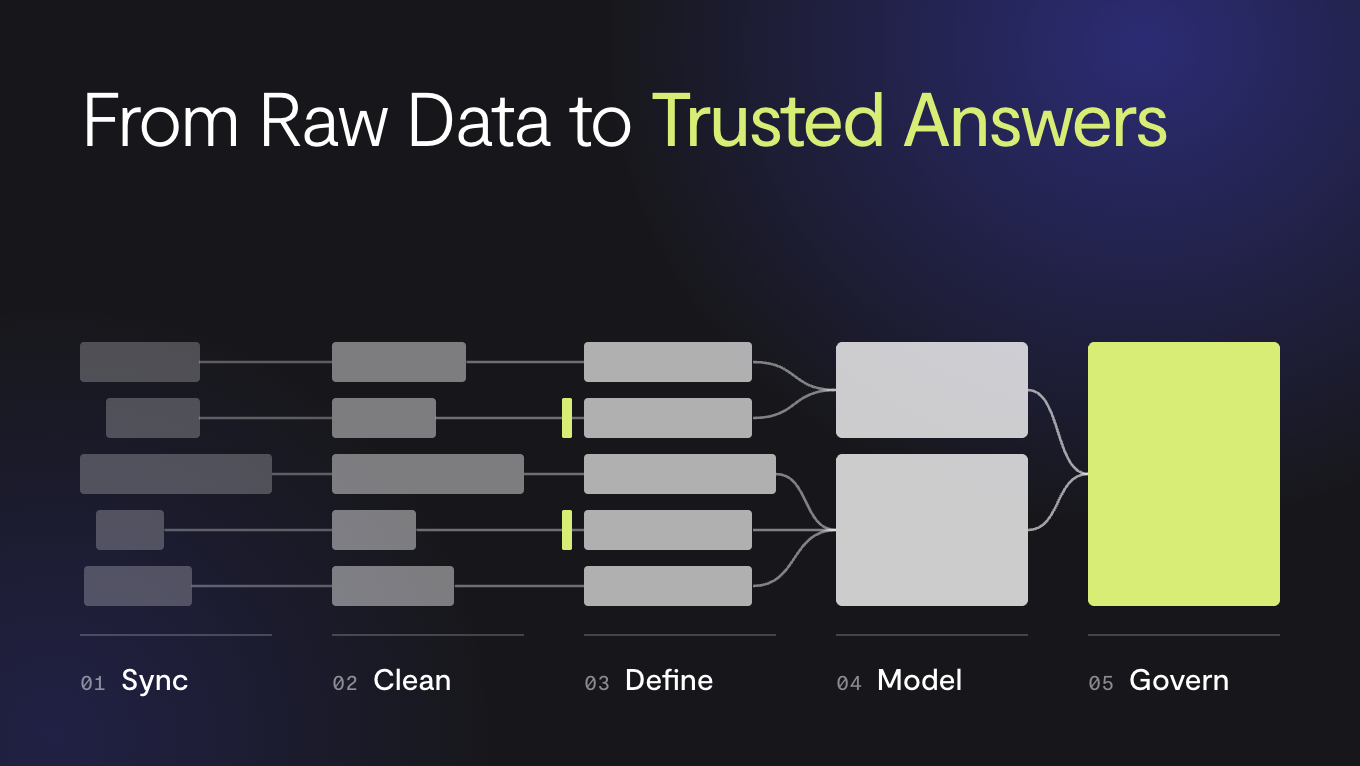
Connect
Every source syncs in, and the Data Dictionary catalogs it automatically.
Reconcile
Raw tables cleaned up and checked against your source systems.
Define
What each metric means, and who's allowed to see what.
Model
Your business built into data models: sales, patients, locations.
Govern
Definitions locked and verified, so every board and AI answer agrees.
Who can reach what, decided once
HIPAA-ready on every account, with access rules that hold for dashboards, AskCorral and MCP alike.

HIPAA-ready, BAA included
HIPAA compliant, with a BAA and SSO on every account. Standard, not an add-on or an upgrade.

Your warehouse or ours
Run on a CorralData-hosted warehouse, isolated per account, or connect your own and we query it in place.

AI that stays inside your BAA
HIPAA accounts only use AI models covered by a BAA. A request for any other model is refused, not rerouted.

PHI hidden from AI
Mask any column so AskCorral and connected AI tools never see the values, while your team still can.

Every read on the record
Each query is logged with who ran it, what it asked for and how many rows came back. Audit-ready by default.

Row Level Security
One board, filtered to each person's rows. AskCorral and MCP are held to the same limits. Explore Row Level Security
Trusted by leading healthcare and wellness brands













Questions we get asked
Three questions about any number you are looking at: where it came from, whether you can trust it, and who is allowed to see it. Most writing on the subject assumes a data team and a steering committee. The questions matter just as much at five locations, they just should not take a committee to answer.
Yes. If you already run a warehouse, we can connect to it and query it in place rather than moving your data. Most accounts do not have one and run on a CorralData-hosted warehouse instead.
We reconcile what lands in the warehouse against your source systems before modeling anything, and do not proceed until it matches within 1%. Whatever is left after that is a definitional difference to agree on, not missing data.
It makes them consistent, and it catches gaps between your source systems and your reporting. It cannot fix a source system that is recording something wrong at the point of entry. What it does is make that error show up the same way everywhere instead of differently in every report, which is usually how it finally gets caught.
Yes. It reads the same governed models your dashboards do. Where Row Level Security is in place, it applies to AskCorral and MCP queries too, not only the interface.
Good SQL lives inside one query. A governed model lives in one place and gets referenced by everything that needs it, so a change happens once instead of getting chased across dozens of reports.
They will, and that is the point of defining them once. Change the definition in the model and every dashboard, export and AI answer built on it moves with it, instead of you tracking down dozens of reports.
Lineage tracing and change history, so you will be able to follow a metric back through every transformation and see who changed a definition and when.
Governed models, the Data Dictionary and standard access controls are part of how accounts get built. Row Level Security is a separate add-on.
Related reading
Go deeper on data governance
Feature Spotlight
Data stack governance: where accuracy is won or lost
Data & AI Insights
From Raw Data to Trusted Answers
Data & AI Insights
AI and Patient Data: What HIPAA Actually Requires
See what one trusted number looks like in your account.
Book a demo and we'll walk through your metrics, not a sandbox.