



 " alt="">

















Business intelligence looks different heading into 2027. Almost every team has tried pasting spreadsheets into Claude or ChatGPT for a quick summary, but that approach breaks down the moment the numbers stop matching and executive decisions are on the line.
Buying an AI subscription is easy. Building reliable agentic analytics, AI that answers questions, recommends next steps and acts on them, is not. It needs a data foundation underneath: connected data across systems, shared metric definitions, and clear governance over who sees what. Most 2027 budgets will include a line for AI. Very few will include one for the data it reads from.
This guide is for owners, executives, technology leaders and PE operating partners, especially in multi-location businesses like healthcare groups. It covers where your organization sits today, what to build versus buy, and how to budget for the data AI depends on.
Three trends reshaping analytics in 2027
Three shifts are changing how businesses get answers from their data, and each one affects what you should buy.
AI is already part of how reporting gets done. Your front desk, your marketing lead and probably your CFO are pasting numbers into ChatGPT or Claude to build reports. So the 2027 question isn't whether to bring AI into reporting. It's whether that use can scale: one setup the whole organization works from, on the same numbers, with customer and patient data kept in enterprise tools covered by the right agreements (like a BAA, if you handle patient data) instead of personal accounts.
Every kind of analytics tool is adding AI, each in its own way. BI vendors are building copilots into tools like Power BI and Tableau. Data platforms like Snowflake and Databricks are adding agents of their own. Some teams skip BI altogether and build their own setup with Claude or ChatGPT, and more analytics platforms are being built for a single industry. They all call it AI analytics, but each covers a different part of the data stack: the infrastructure underneath, querying and visualization, or the AI agents on top. Few cover all of it. Because they share a label, buyers often treat them as like for like, or aren't sure how to compare them at all.
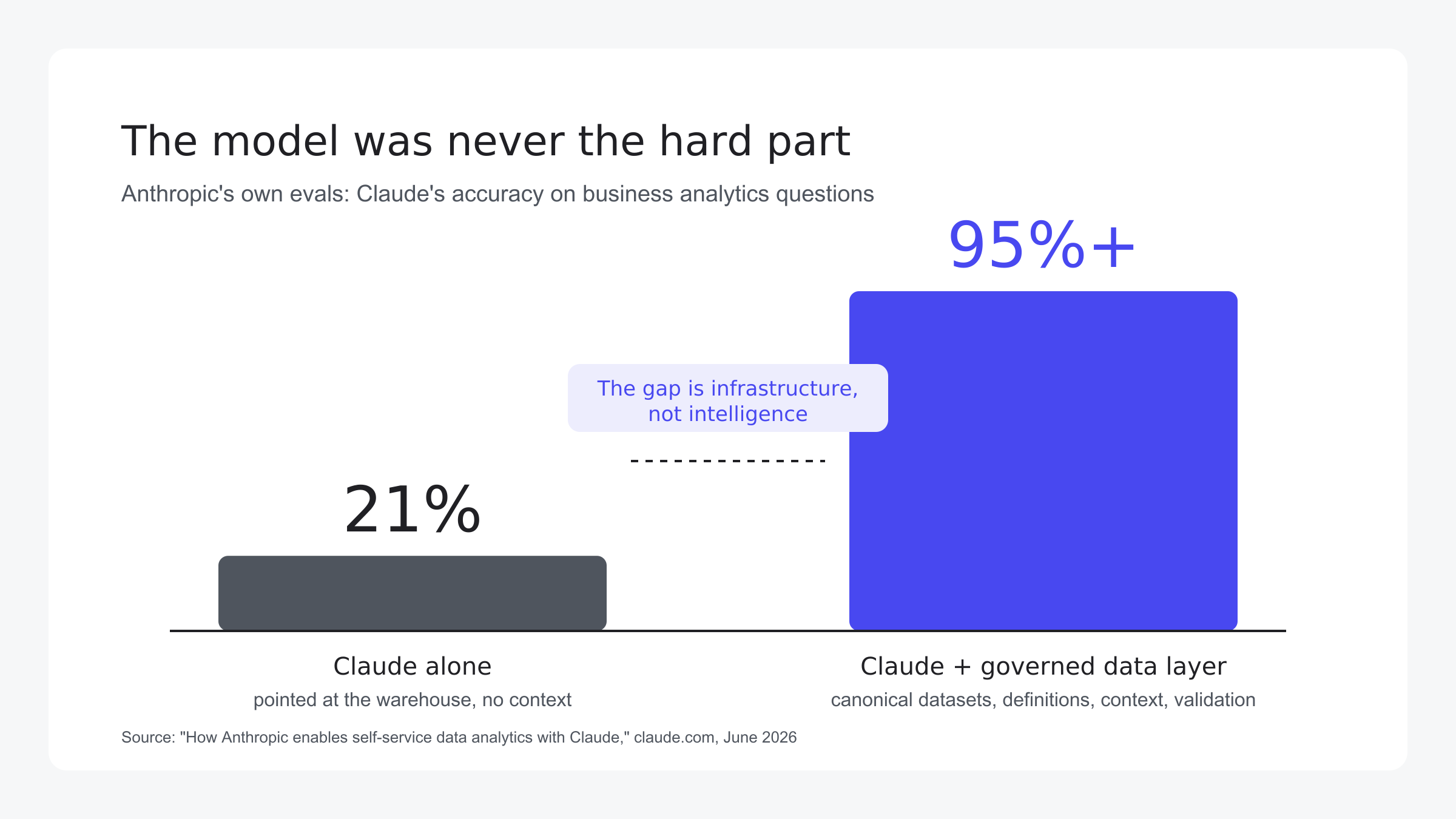
Most teams aren't equipped for agentic analytics yet. Companies are spending on agentic AI well ahead of the data it needs, as Fivetran's 2026 Agentic AI Readiness Index shows below. Only 15% of companies surveyed are fully prepared to run agentic AI. That gap shows up in the accuracy of analytics as well. When Anthropic tested its own analytics agent, accuracy on its internal evals didn't exceed 21% without skills. Adding curated skills, the instructions and context the agent reads, put accuracy consistently above 95% in aggregate. Anthropic also says that context has to be maintained: without upkeep, the skill docs go stale and accuracy slips. We break down those numbers here. For buyers, the lesson is to evaluate the context alongside the model: the data, definitions, and instructions it uses, and who keeps them current.
"Most companies aren't failing at AI because of the models, they're failing because their data isn't ready."
George Fraser, CEO, Fivetran
Where are you today?
Most organizations sit in one of three stages, from manual reporting to fully connected, governed data. The stages aren't new. Large enterprises have run at the top stage for years, with a warehouse, cleaned and modeled data, a reporting layer, and a team of engineers and analysts to run it. What's changed is that AI can now do much of the work those tools and people did, which changes what it costs and puts the most sophisticated stage within reach of businesses that couldn't build and staff it before. That said, it also tempts teams to bolt AI onto manual reporting and skip the foundation, which is a trap: the answers come fast, but can be unreliable.
Here's what each stage looks like today, with AI in the picture. Use this to assess the current standing of your organization and understand what you could be missing.
| Stage | What it looks like | What you're missing | What to add to move up |
|---|---|---|---|
| 1. Manual reporting | Source systems and spreadsheets. Each system's built-in reports, plus exports stitched together by hand, maybe with AI on top for charts and summaries. No warehouse and no BI tool. Leadership still debates what counts as a new customer or patient. | A full picture across systems and locations. Answers depend on whoever built the spreadsheet, numbers rarely match from one report to the next, and customer or patient data pasted into personal AI tools is a compliance risk. | Stack: a BI tool connected to your main systems, and enterprise AI tools covered by the right agreements. Strategy: write down how you define your core metrics, even in a shared doc. |
| 2. BI on partly connected data | A BI tool like Power BI or Tableau, often on a warehouse or a few connected sources. Metric definitions live inside individual reports or an analyst's SQL, with no semantic layer. New questions wait on a person, and two reports can still disagree. | Answers you can trust and get quickly. Dashboards only answer the questions someone built them for, every new question waits in an analyst's queue, and AI copilots guess at your definitions. | Stack: a warehouse with every source connected, a semantic layer, access rules, and AI agents that query the semantic layer. Strategy: agree on the metrics leadership runs on, and prove the numbers tie back to your source systems. |
| 3. Connected, contextual and governed | A warehouse, a semantic layer that holds your business context, and governance over who sees what. This is what makes agentic analytics accurate: AI that answers questions and recommends what to do, from data the team trusts. | AI that acts. Insights still wait on someone to read them and do the work by hand. | Stack: connections that let AI act in your other tools: activation (reverse ETL) to send lists and segments into your CRM or ad platforms, and MCP connections so AI agents can work directly inside tools like your CRM or scheduling system. Strategy: set approval rules for what AI can do on its own, and pilot with one location. |
If what you're missing affects decision-making, revenue opportunities, is a compliance risk, or reporting is too slow, it's time to take the next step.
If you're at stage 1, AI on top of spreadsheets may be enough, but only in specific scenarios. There are teams that are skipping BI tools entirely and doing their analysis in Claude or ChatGPT, which can now build dashboards too. Sometimes that's the right call, and you may not need to move up a stage at all. If your spreadsheets are already clean, one person owns them, and what you want is faster charts and quicker analysis, go do that. It costs a subscription, not a project.
It stops working when the question changes from "can I chart this faster?" to "can everyone ask questions of our data and trust the answer?" The usual signs:
- More than a handful of people need answers, and they're getting different numbers.
- The data comes from more than two or three systems, and someone has to export from each one every time, so the AI is always working from an out-of-date snapshot.
- Leadership, a board or a PE sponsor needs numbers they can trace back to the source. An AI answer built on hand-edited exports can't show its work the same way twice.
- Customer or patient data is involved, and the AI tool isn't covered by the right agreements, like a BAA if you handle patient data.
- You want AI to act on the data, not just describe it.
If you're at stage 2, you've made real gains over stage 1, but you're not unlocking what AI can actually do. Dashboards refresh on their own, some sources are connected, and leadership has numbers to review every week. That's real progress. But your metric definitions still live inside individual reports, so an AI copilot on top gets you faster charts built on the same disagreements, not answers anyone can trust on their own.
The usual signs you've hit the ceiling:
- Two dashboards show different numbers for the same metric, and someone has to explain why.
- Every new question goes into the analyst queue, because dashboards only answer what they were built for.
- An AI copilot gives a different answer depending on how the question is phrased.
- AI usage, and the bill for it, keeps climbing, but trust in the answers doesn't.
- Adding a location or an acquisition means rebuilding reports.
- Some sources are still exported by hand, so the warehouse never has the full picture.
To get to stage 3:
- Find where your definitions live today, usually scattered across reports and an analyst's SQL, and agree on the 10 to 15 metrics leadership actually runs the business on.
- Move those definitions into a semantic layer, so every report and every AI answer pulls from the same logic.
- Connect the sources that are still exported by hand, and set access rules by location or role before anyone new gets in.
- Prove the numbers tie back to your source systems, then point AI at the semantic layer, not at raw tables.
This is where most of the effort goes, and where the build vs. buy decision below matters most.
If you're at stage 3, your AI gives answers you can trust, but it isn't acting on them yet. Answers are fast, consistent and traceable, and people actually use them. But every insight still waits on someone to read it, decide, and do the work by hand.
The usual signs you're leaving value on the table:
- The same issue keeps surfacing, like a dip in rebooking, and the fix is always the same manual work.
- Your team spends more time turning answers into lists, campaigns and schedule changes than finding the answers.
- Good recommendations sit in a dashboard or an inbox, and nobody acts on them in time.
- The AI can tell you what to do, but it can't do it in the systems where the work happens.
To get ready for AI that acts:
- Pick one or two workflows where a clear signal should trigger an action, like a drop in rebooking or a spike in no-shows.
- Set approval rules up front: who approves, what the AI can do on its own, and where it has to stop.
- Connect AI to the systems where those actions happen, through activation (reverse ETL) or MCP connections to tools like your CRM, scheduling or ad platforms.
- Keep a record of what the AI recommended, what was approved and what changed, so you can measure the results.
- Pilot with one location or region, then expand.
If what you're missing affects decision-making, revenue opportunities, is a compliance risk, or reporting is too slow, it's time to take the next step. If it isn't, stay put.
Plan for the stage you're moving into, not the one you're in. That tells you what to buy, and what to budget.
If you're a PE operating partner, run the check per platform company and look at the gap between the strongest and weakest. That gap is usually where the 2027 budget should go. It pays off at exit, too: a company that can show clean revenue by location, provider or staff member, and service line, tied back to its source systems, gets through diligence faster than one rebuilding the numbers in spreadsheets.
The next section covers the full data stack each step builds toward.
What you need to run agentic analytics
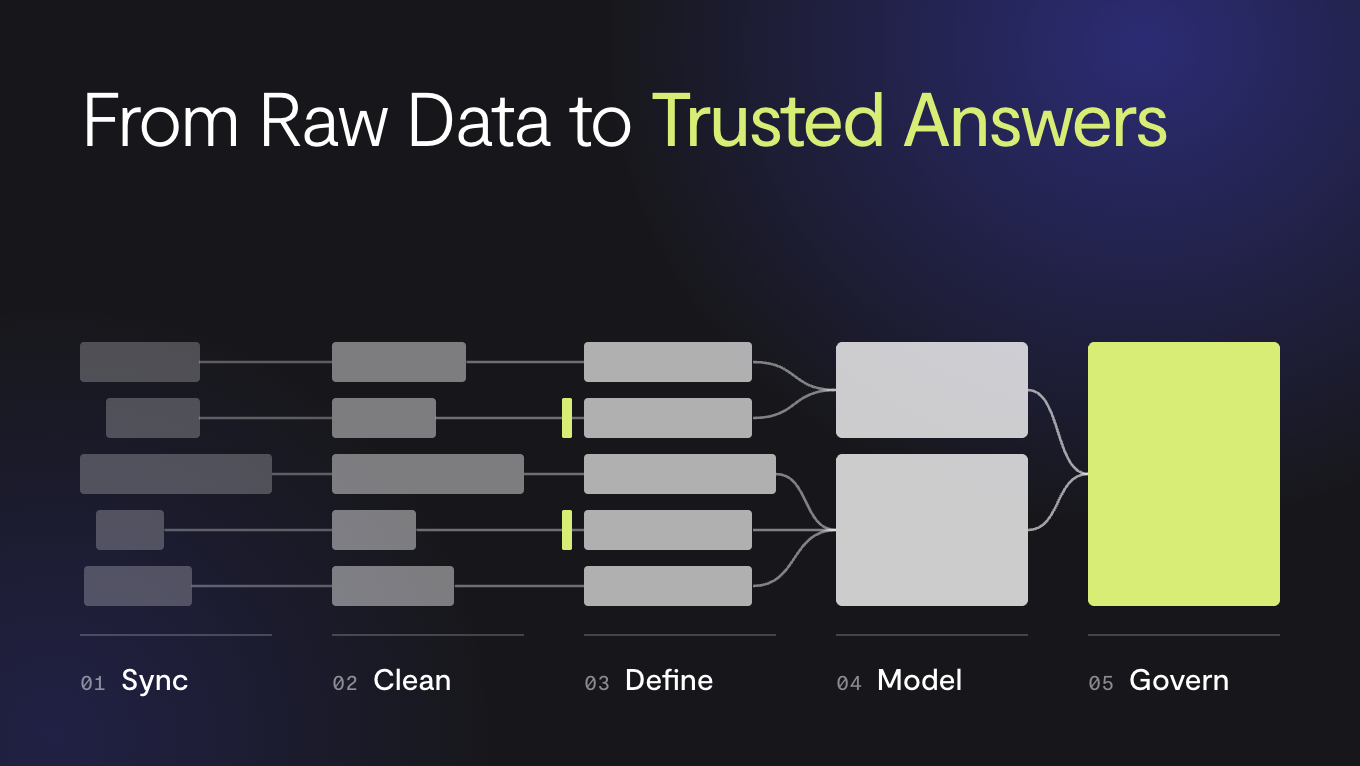
Getting from manual reporting to accurate agentic analytics takes a data stack with six layers on top of your source systems. You need all of them whether you buy one product or five. The budget question is who provides each layer and who keeps it running. If your last analytics project was a BI rollout, expect fewer tools, fewer specialists, and answers on demand instead of a report queue.
Skipping straight to AI is where businesses get burned. Buy an AI analytics tool before you have standard metric definitions or a data strategy, and the AI has nothing consistent to reason from, so nobody trusts its answers. That groundwork has to come first, whether your own team does it, a strategy partner does, or it comes with a platform's onboarding.
You need all six layers whether you buy one product or five. The question is who provides each one and who keeps it running.
| Layer | What it does |
|---|---|
| Ingestion and transformation | Pulls data out of your core operating system (EMR, PMS, POS or ERP), CRM, ad platforms and accounting, then cleans and standardizes it into data models: consistent tables for customers, appointments, revenue and so on, joined across systems |
| Data warehouse | Stores everything in one place, with security controls (HIPAA, if you handle patient data) and access rules |
| Semantic layer | Sits on top of your data models and defines what each metric means and how data connects, so every report and AI answer agrees. It's what lets the AI give the same answer to the same question every time, instead of guessing. It also cuts how much the AI has to read and write to get an answer, which lowers AI usage costs (see "AI spend can spiral on the wrong foundation" below) |
| Visualization | The dashboards, reports and apps your team looks at |
| AI agents | Queries your data to answer questions in plain language, builds charts and dashboards on request, flags changes worth a look, recommends actions and, once approved, takes action in your other tools |
| Activation | Puts results to work in the systems that run the business: reverse ETL sends lists and segments to your CRM or ad platforms, and MCP connections let AI agents act directly inside tools like your CRM or scheduling system |
New to these terms? Our Data Foundations Guide explains each layer in plain English.
Most tools cover one layer well. Here's how the common categories compare:
| Ingestion and transformation | Warehouse | Semantic layer | Visualization | AI agents | Activation | |
|---|---|---|---|---|---|---|
| ETL tools | Full | |||||
| Data warehouses | Full | Partial | ||||
| Semantic layer tools | Full | |||||
| BI tools | Partial | Full | Partial | |||
| AI assistants on their own (ChatGPT, Claude) | Partial | Full | Partial | |||
| Reverse ETL tools | Partial | |||||
| All-in-one managed platforms (e.g. CorralData) | Full | Full | Full | Full | Full | Full |
Breadth isn't the same as depth. Point tools usually go deeper in their own layer: Fivetran has more prebuilt connectors than any all-in-one platform, and Tableau has more ways to visualize data. A managed platform is built to make the layers work together instead, so you get one vendor to manage, one set of metric definitions that everything uses, and no engineering work on your side. Which fits better, several point tools or one managed platform, depends on whether you have a data team to run the point tools.
Where MCP connections fit
MCP (Model Context Protocol) is a standard way to connect AI assistants like Claude and ChatGPT to your other tools. It works in two directions. AI can read through it, querying your data from the assistant your team already uses. And AI can act through it, like drafting a campaign in your CRM or updating a schedule. More vendors now offer an MCP connection, so you can often bring the AI you already pay for instead of buying another one.
What MCP doesn't do is fix the data underneath. An assistant connected straight to raw tables still has to guess what your metrics mean. The connection is only as accurate as what it reads from, so connect it to your semantic layer, and treat its actions like any other: with permissions and approval rules.
What changes in your day-to-day
Take a regional director who sees revenue dip at one location.
The old way. She spots the dip in Tuesday's report and emails the analyst. The request waits behind the board deck. By Friday, the analyst finds that cancellations jumped for two providers. The team plans outreach the following week, about 10 days after the dip started.
With agentic analytics. Overnight, the agent flags the dip and traces it to the jump in cancellations for those two providers. When she opens her inbox the next morning, a rebooking list and a draft outreach message are waiting for her review. Same data, same definitions, and the fix starts that morning.
AI spend can spiral on the wrong foundation
One cost many organizations don't realize they'll incur is AI usage. AI is priced by tokens, the units of text it reads and writes. Every question, every query it runs and every follow-up uses them, and prices vary by model.
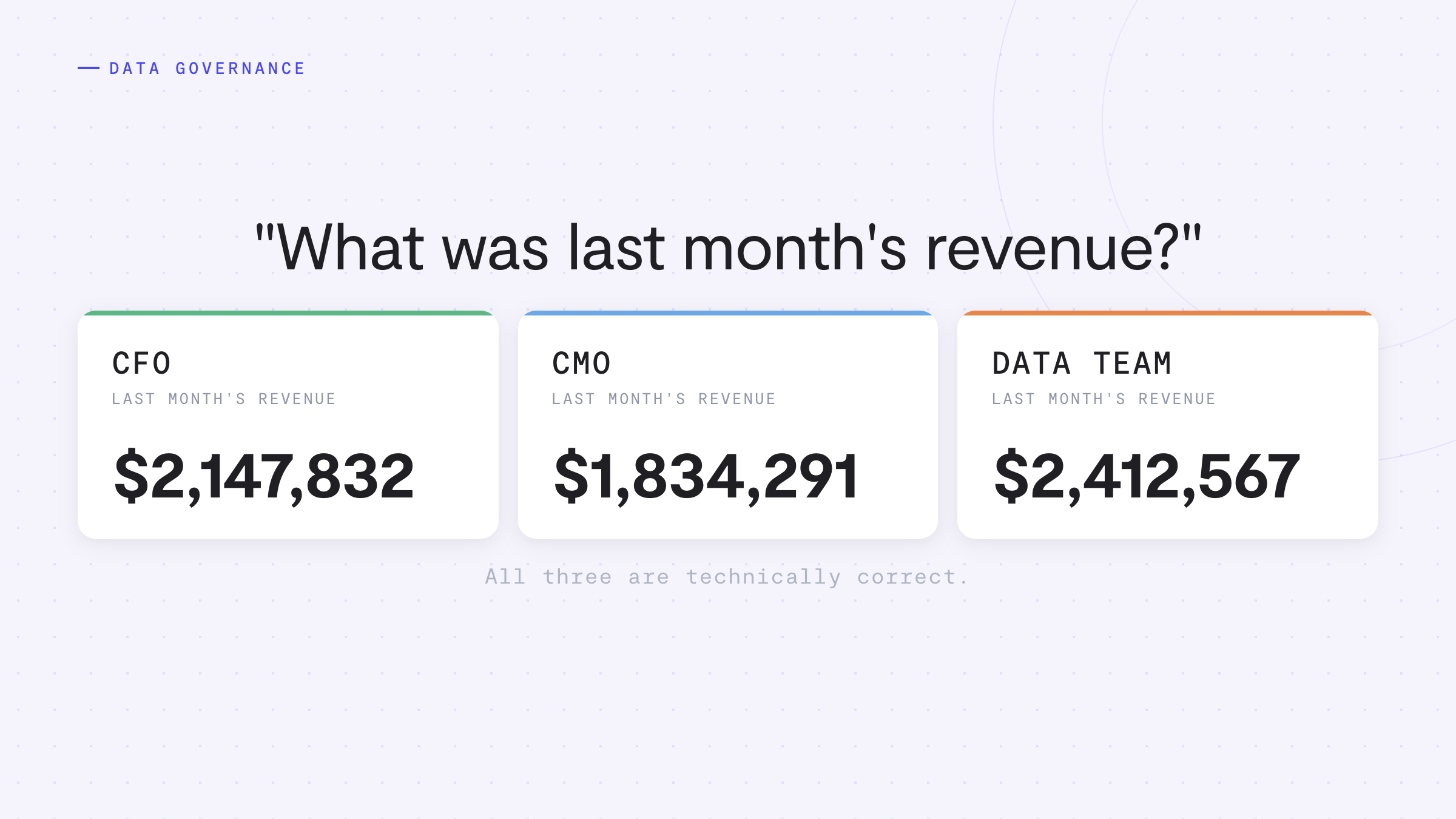
A semantic layer, built on clean data models, cuts that usage. When the AI starts from your agreed metric definitions, it doesn't have to work out what "revenue" means, which tables to use or how they join. Without them, it rediscovers all of that on every question, and the numbers can change depending on how you ask. With them, it runs fewer queries and needs less back-and-forth to get to an answer. The same definitions that make answers accurate also make them cheaper.
We found the same pattern in our own AskCorral tests: giving the AI governed metric definitions raised accuracy from 31% to 98% and cut cost per answer roughly in half, with faster median time-to-answer and numbers that stayed consistent when the question was rephrased.*
Your results will depend on your data and questions. But the pattern holds: the foundation, not the AI seat, decides what your AI spend buys.
Whether that shows up as a bigger bill depends on how you buy AI. If you build your own stack on an AI provider's API, you pay for every token. Seat-based AI tools usually include a monthly allowance, so heavy use means buying more or hitting a limit. Managed platforms vary: some pass usage through, some include it. It's one more line to compare in the numbers below.
Here's how using AI on raw tables compares with using it on a semantic layer:
| Ask AI on raw tables | Ask AI on a semantic layer | |
|---|---|---|
| What it does | Rediscovers joins and metric definitions every time | Uses agreed metrics and joins |
| Accuracy | Drift, retries, answers that "sound right" | Matches the dashboard |
| Governance | Guesses who can see what | Access rules already applied |
| Cost pattern | High token use, follow-ups, re-asks | Fewer round trips, stable answers |
| Feels like | Spiraling spend and low trust | Spend that buys answers you can use |
Same AI. Same question. Different foundation.
* Internal CorralData tests on sample data, not a customer case study.
Build vs. buy: the real numbers
There are two ways to put that foundation in place: build the data stack yourself, or buy it as a managed platform. Below, both are priced for an example group with 10 locations and 25 people who need access to the numbers. Year 1 includes setup, and the ranges come from public salary and pricing data.
| Build your own data stack | Managed platform (CorralData example) | |
|---|---|---|
| Best for | Larger organizations with a data team, strict IT policy or niche sources | Multi-location businesses that want agentic analytics without hiring a data team |
| People, per year | $230K to $330K: a data engineer, plus an analyst or contractor | No new hires or technical resources needed. Our team builds and runs it. Some platforms still expect you to have a data engineer or analyst. |
| Software, per year | $20K to $80K: pipelines, warehouse, BI and AI tools | About $36K a year for 10 locations |
| AI usage | Varies with volume, and not included in the totals: billed per token by your AI provider, on top of AI tool seats, and higher without a semantic layer | AI usage included in this example; confirm plan allowances and any limits in your quote. Many platforms include a monthly AI credit allowance and charge for more. |
| One-time setup | $15K to $100K: implementation and onboarding for BI and pipeline tools | About $5K for onboarding a 10-location group. In this example, that onboarding includes 40 hours of guided setup. Other platforms may also charge for implementation or professional services. |
| Year 1 total | $265K to $510K (AI usage not included) | About $41K |
| Each year after | $250K to $410K (no setup; AI usage not included) | About $36K |
| Time to first trusted dashboard | Often 6 to 12 months | 4 to 6 weeks |
| What it doesn't cover | You own the upkeep, security, and the agreements (like a BAA, for patient data) with every vendor that touches sensitive data. | Fees your EMR, PMS or POS vendor may charge for API access, and an internal owner for decisions on definitions. |
See the appendix for line-by-line build costs and where each number comes from.
What building it actually involves. Each source system is its own project. Your EMR or POS, CRM, phone system and accounting software each need a pipeline with its own access, rate limits and data model, and each one has to be watched and fixed when the vendor updates its system. Once the data lands, someone has to match customers or patients, staff and locations across systems before any two reports agree. Then come the metric definitions, the access rules and the dashboards. One engineer can carry that for a while. It usually stretches thin at the second or third system, or the first acquisition.
Why some companies still build their own. It's the most expensive path, and for some it's still the right one: when they already have a data team and a warehouse, when IT policy requires data to stay in their own cloud account, or when they have niche sources no vendor supports.
When a managed platform fits better. It's usually the right call when you run several locations on the same core systems, don't have a data team and don't want to hire one, and need trusted numbers in weeks rather than months, for a fraction of what a build costs. It also fits groups that are growing by acquisition, since each new location connects to data models that already exist, and teams that handle patient or customer data and want one vendor to sign the agreements and own the security.
If you run several locations and don't have a data team, a managed platform gets you trusted numbers in weeks, for a fraction of what a build costs.
What to ask before you sign
Whichever path you choose, these questions separate a vendor who has done this in your industry from one who is learning on your data. Ask us too.
- Which parts of the data stack does your platform handle (data ingestion, warehousing, data modeling, dashboards, AI), and what would we need to buy or build separately? Some tools are a warehouse with AI agents, some sit on top of a warehouse you already own, and some cover the whole stack. Map each vendor to the six layers above before comparing anything else.
- Do you have native integrations with our systems, and are they live with other customers today? Name your core operating system (EMR, PMS, POS or ERP), CRM, phone system and accounting software. "We integrate with everything" is not an answer. Ask what has already run in production.
- How are metric definitions set up and maintained, and can we see and edit the logic behind them? You should be able to read how "new customer" or "location gross margin" is calculated, and change it when your business changes.
- When we acquire or open a location, how long does it take to add it to reporting, what does it cost, and who does the setup: your team or ours? For a growing group, this matters more than the price on day one.
- Who owns our data, and can we export it or query it directly if we leave? Your data should live somewhere you can reach directly, not only through the vendor's screens.
- What data does your AI query, and how do you keep its answers consistent with our reports? If two people ask about revenue, they should get the same number. Ask how the vendor makes sure of that. An AI that has to rediscover your definitions on every question also runs up more usage.
- What's the all-in annual cost for a business our size, including onboarding, AI usage and any third-party tools we'd still need? Ask about seats, integrations and any API fees your software vendors charge, too. AI usage is often billed separately from AI seats, based on how much the AI reads and writes, so ask for an estimate at your volume. Usage-based, seat-based and per-location pricing don't compare directly, so price each option for a full year at your size.
- What's your typical implementation timeline, from kickoff to reports our team relies on? Ask for a realistic timeline for your stack, not a best case.
- Can your AI take action in our other systems, and how do approvals work? Ask what it can do on its own, who signs off, and whether there's a record of what it recommended and what changed.
- Do you offer MCP connections, and what can they do and not do? Ask whether AI connected through MCP reads the same metric definitions as your reports, whether it can take actions or only read data, and whether your access rules and approvals still apply.
If you handle patient data, see our guide to what HIPAA actually requires when AI touches patient data.
Making the call for 2027
The businesses that pull ahead in 2027 won't be the ones with the most tools. They'll be the ones whose team, and whose AI, trusts the same numbers. That starts with what you decide to buy, and budget for, this quarter.
Start by placing yourself on the three stages above, compare build and buy at your own size, and take the vendor questions into every demo you book, including ours.
Where CorralData fits
CorralData is built for businesses that want the data foundation and agentic AI without building it all themselves. It's one HIPAA-compliant data and AI platform that covers all six parts of the stack. Here's how we answer the questions above:
- Which parts of the data stack? All six: ingestion, warehouse, semantic layer, dashboards, AI agents and activation, run by our team. There are no separate data tools to buy.
- Integrations? 600+, covering EMRs and practice management systems, POS systems, CRMs, ad platforms, phone systems and accounting. No engineering required on your side.
- Metric definitions? We start from standard definitions for your industry, build them with your team, and check every number against your source systems. You can see the logic behind each one.
- New locations? Our team connects them to the same data models, and pricing grows by location, not by headcount.
- Data ownership? Your data stays yours. We can run on a warehouse you already own, or host it for you.
- AI? AskCorral, or Claude and ChatGPT through MCP, all query the same governed data models, so AI answers match your reports. AI usage included in this example; confirm plan allowances and any limits in your quote.
- Approved actions? Our AI agents recommend and stage the fix, like a reactivation segment or a shift in ad spend, in the systems you already use. Nothing goes out until someone on your team approves it.
- Cost? $300 per location per month billed annually, with unlimited users, a BAA and a named technical account manager. In the 10-location example above, about $5K of onboarding includes 40 hours of guided setup.
- Timeline? Onboarding typically takes four to six weeks.
See what CorralData looks like on your data
If you're still doing manual reporting, we help you define the basics before anything else gets built. If you're running a DIY stack that isn't paying off, we can replace it. Either way, the work starts from your own data.
Book a DemoAppendix: what building your own costs, line by line
Building your own is the path with the most moving parts, so here it is line by line. Each range runs from a lean setup to a fuller one, for the same 10-location example, priced for a group that handles patient data and needs HIPAA-ready tools.
| Line item | Annual cost | Basis |
|---|---|---|
| Data engineer, full time | $186K to $265K | Robert Half 2027 salary guide ($130.5K to $185.5K base), plus benefits at 30% of compensation (BLS) |
| Analyst or part-time contractor | $46K to $170K | A part-time contract engineer at $92 to $184 an hour (Second Talent), up to a full-time analyst (Robert Half) |
| Pipelines (ETL) | $6K to $48K | Fivetran's published example for four connectors, up to the median Fivetran contract (Vendr) |
| Data warehouse | $6K to $36K | Snowflake Business Critical at $4 a credit, the edition Snowflake requires for patient data |
| Transformation and semantic layer | $0 to $6K | Free dbt Core, up to dbt Cloud at $100 per developer per month |
| BI licenses, 25 users | $4K to $88K | Power BI Pro at list price, up to the median Looker contract (Vendr) |
| AI access, HIPAA-ready | $0 to $18K | Claude Enterprise at $20 per seat per month plus usage. The Team plan isn't HIPAA-ready. |
| Reverse ETL | $0 to $15K | The median Hightouch contract (Vendr) |
| Setup, year 1 only | $15K to $100K | Implementation and onboarding services for BI and pipeline tools (Vendr) |
Most builds land between $250K and $410K a year to run, which is the range in the main table. Enterprise-grade tools can push it past $600K. Not included: variable AI usage (it varies with volume and is not in those totals), recruiting and turnover, and data observability tools.