🤖 Anthropic published the playbook for self-service analytics with Claude. Here's the fastest way to run it.

01 · Overview

How onboarding works, and what to expect

What we build at each phase, what we need from you, and the most common scenarios that affect your timeline. No surprises.

Your source systems

Platforms & data sources

EMR, CRM, billing, ads, payroll. Wherever your data lives, you own the vendor relationship and hold the keys to access.

CorralData

Technical infrastructure

Connects your sources, transforms and models your data against the logic you define, and surfaces it as dashboards, AskCorral, and MCP.

Your business logic

Definitions & governance

How your business defines what it measures. Metric logic, edge cases, cross-system mapping: the spec we build to.

↓

Output

CorralData

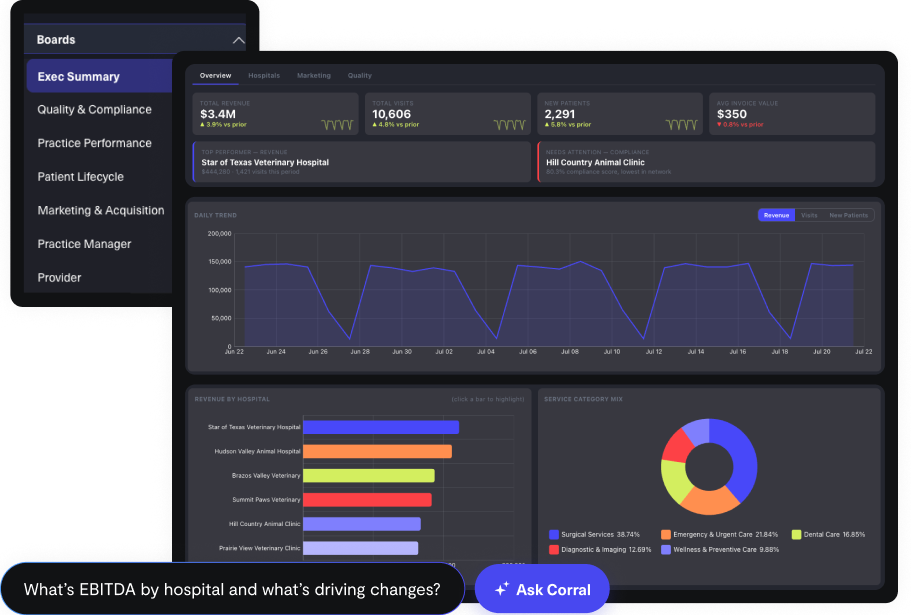
Dashboards & widgets
AskCorral AI
CorralData MCP

02 · Ownership

Ownership

CorralData handles the full technical build. The inputs below are yours to provide. The faster and more completely you deliver them, the faster onboarding moves.

Your relationship

Source systems

  • API credentials and admin access for each system
  • Vendor account ownership and relationship
  • Third-party API enablement requests
  • IT approval and security review timelines
  • Timing of access is entirely in your control

Your ownership

Business logic

  • Designated onboarding lead with decision-making authority. This person doesn't need to be technical, but does need to know your business and have the authority to make calls.
  • Metric definitions: how your business calculates what it measures
  • Definition sign-offs and ongoing governance
  • Cross-system record mapping where needed
  • Validation review and benchmark comparison
  • Training coordination and end-user attendance

Our ownership

CorralData

  • Data warehouse: where all your data is stored and processed
  • Data ingestion: connectors and sync pipelines from every source
  • Sync health monitoring and ongoing pipeline reliability
  • Transformations: raw data cleaned, shaped, and standardized
  • Data models: your business logic encoded and maintained
  • CorralData platform: dashboards, widgets, and reporting
  • AskCorral AI: the intelligence layer built on your governed data
  • CorralData MCP: AI agent access to your data via any MCP-compatible tool

03 · Process

The onboarding process, start to finish

1

Data connection

We connect your contracted data sources and validate that data is flowing. This phase is gated entirely on access. We can't build what we can't reach.

1 to 5 days
What CorralData is doing
  • Sending you a connect URL to authenticate each data source
  • Configuring and testing connectors for each contracted source
  • Validating all initial syncs complete without errors, with only core tables flowing
  • Setting up sync health monitoring so we catch issues before they reach you
  • Running initial data profiling: what exists, quality issues, any gaps
What we need from you
  • API credentials or admin access for each contracted system
  • Flag any source that requires vendor or IT involvement to unlock
  • Prompt responses when we hit a connection issue or need a credential confirmed

Common scenarios

Multiple people are running point on your side

Credential ownership can be split. Project leadership can't.

Blocker risk

Different systems can have different credential owners, and that's fine. But for the day-to-day of onboarding, working with our team and moving the project forward, you need one solid leader. We've seen onboardings stall when three or four people rotate in from the customer side, each with a different answer to the same question. We need a senior leader, someone available to engage throughout the process and empowered to make critical business decisions, who owns communication with us from kickoff through go-live. They can pull in IT, finance, or credential owners as needed, but the decisions and the answers come through them.

Timeline impact: every extra voice in the room adds coordination overhead, not clarity.

  • Name one senior leader before kickoff, available to engage throughout and empowered to make business decisions. Everyone else routes through them.
  • Credential ownership can stay distributed across systems, that's normal. Project leadership shouldn't be.
  • If your leader changes mid-onboarding, tell us immediately and get the new person caught up before the next session.

Your system doesn't have an API, or it's locked

Not all platforms support external data connections

Blocker risk

CorralData connects to 600+ sources, but not every system has a usable API. Some platforms lock data behind their own dashboards. Others require a formal vendor request to enable external access. This is a conversation we'd rather have in week one than week four.

Timeline impact: varies, days to indefinite depending on the system

  • API we haven't built for yet: custom connector build, typically 2 to 4 weeks
  • Limited or undocumented API: we assess, give you a realistic range, and build if feasible
  • No API at all: we explore alternatives, scheduled exports, manual uploads, or middleware, and tell you the tradeoffs honestly
  • Vendor approval required: we initiate the request, but the vendor controls the timeline. Submit immediately, don't wait for kickoff.

The person with access is unavailable

IT approvals, vendor contacts, the one person who knows the password

Adds time

Credential delays are the most common early bottleneck. Access to a system often lives with one person, and when that person is out, onboarding pauses. Every day of delay here pushes your go-live date.

Timeline impact: 1 day of delay equals 1 day pushed. It compounds.

  • Map out who holds credentials for each contracted system before kickoff
  • If someone with access has upcoming travel or is hard to reach, flag it to your TAM immediately
  • If IT approval is required, initiate the request before the kickoff call, not during it
  • Your onboarding lead needs a direct path to every credential holder
Phase 1 complete when
  • All contracted sources are connected and syncing without errors
  • Sync schedule confirmed: you know how fresh each source is
  • Only core, approved tables flowing, no unnecessary data
  • Data profiling complete, known quality issues documented

Typical duration when smooth: 1 to 5 days

2

Discovery: definitions & custom logic

The most important conversation in your onboarding, and the one customers are least prepared for. We gather how your business defines what it wants to measure.

3 to 5 days
What CorralData is doing
  • Running a structured discovery session to walk through your key metrics
  • Documenting definitions: what counts, what doesn't, how edge cases are handled
  • Defining your data model strategy and creating your onboarding buildout plan
  • Identifying any custom logic that needs to be built vs. what's standard
  • Flagging any metrics that require cross-system mapping, and what that means for Phase 3
What we need from you
  • Your onboarding lead, present and prepared. This session needs a decision-maker in the room.
  • Answers to definition questions we'll send in advance
  • Any existing reports, KPI docs, or dashboards, even rough ones
  • If migrating from another tool: the underlying calculation logic, not just screenshots
  • If cross-system mapping is flagged: name a specific owner on your side before Phase 3

Common scenarios

Your team can't align on metric definitions

Different people have different answers to the same question

Adds time

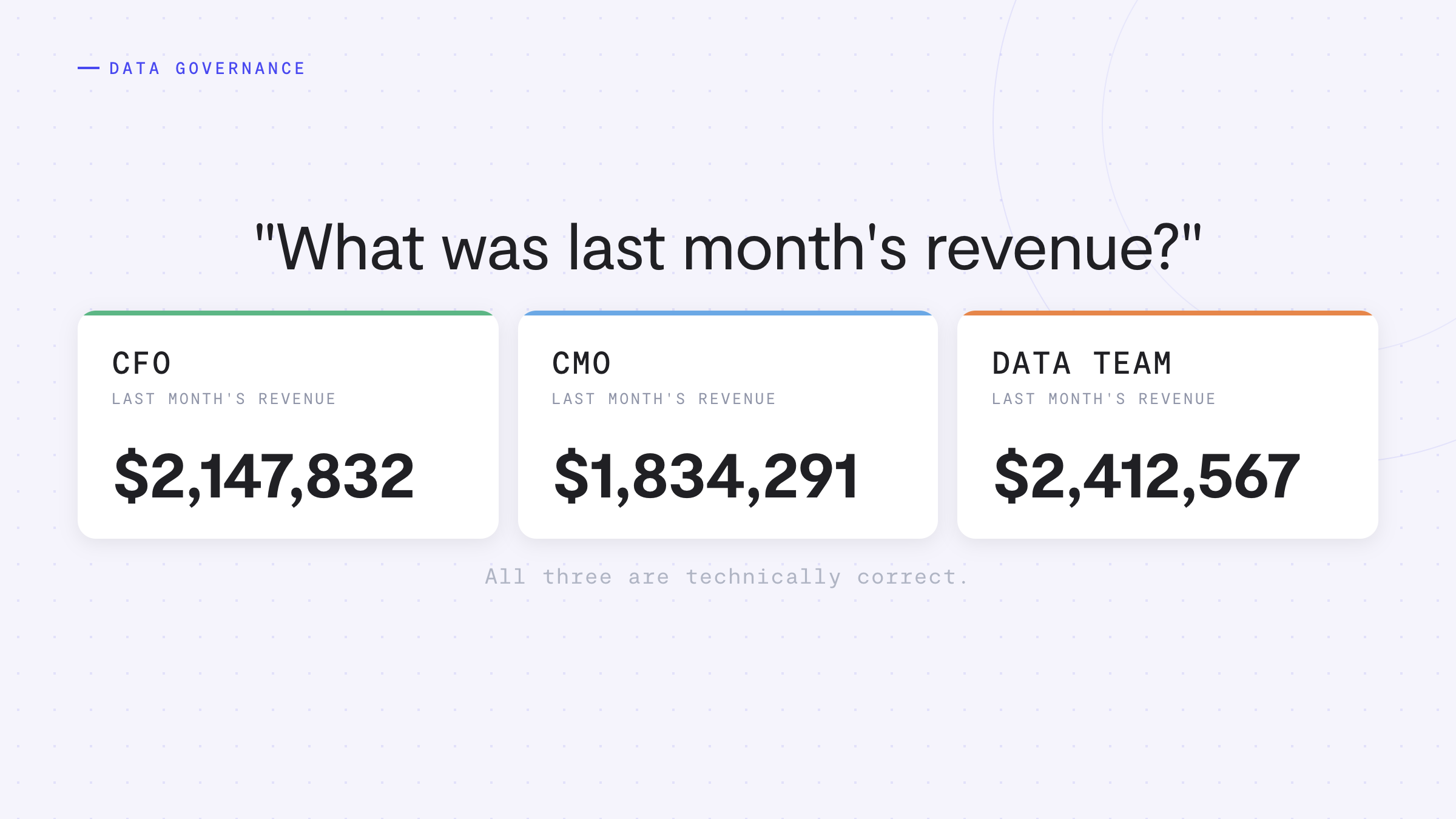
Finance says revenue is net collections. Operations says it's scheduled services. Marketing says it's what got booked. All three are defensible. None of them are the same number. We can't build until there's one definition, and we can't make that call for you.

Timeline impact: unresolved definitions means nothing gets built

  • Before the discovery call, review the prep questions we send and identify where your team doesn't have a shared definition
  • Get the right stakeholders in the session to reach a decision. Hold a pre-meeting to align first if needed.
  • Your onboarding lead needs the authority to lock a definition when the team disagrees, or a fast path to whoever does

Definitions keep changing after we've started building

New stakeholders weigh in, someone changes their mind

Requires rebuild

A definition that changes after a model is built means the model has to be rebuilt. Definition changes cost time proportional to how far downstream the change is. A change before we build is fast. A change after dashboards are live can be time intensive.

Timeline impact: depends on timing, earlier changes cost less

  • Treat the discovery sign-off as a real decision point, not a draft
  • If a definition needs to change, tell us immediately. The sooner we know, the less rework.
  • Limit who can trigger a definition change. If anyone can casually request a recalculation, expect a slow onboarding.

You want to match numbers from a previous tool

Tableau, Power BI, Excel, your EMR's built-in reports

Heads up

Replicating another tool's logic is doable, but only if we understand the logic, not just the output. A screenshot tells us the target number but not which records were included, how edge cases were handled, or what filters were applied. We can match your numbers. We need to see how they were built.

Timeline impact: fast with documentation, slower without it

  • Pull any underlying SQL, formula docs, or calculation notes and share them in week one
  • If the person who built the original reports is still available, a 30-minute walkthrough is worth more than any screenshots
  • If documentation doesn't exist, tell us early. We'll reverse-engineer what we can and be explicit about where we're inferring.
Phase 2 complete when
  • All key metrics are defined, documented, and signed off
  • Data model strategy agreed upon and onboarding buildout plan confirmed
  • Any cross-system mapping work has a named owner and timeline
  • Previous tool logic, if applicable, shared and understood

Typical duration when smooth: 3 to 5 days

3

Validation & data modeling

With definitions locked, we build. We encode your business logic into the data and deliver a v1 for you to review before full dashboard buildout.

2 to 3 weeks
What CorralData is doing
  • Building data models that encode your defined business logic
  • Providing a mapping template for any metrics that require cross-system data
  • Delivering v1 work to you for review
  • Working through your v1 feedback together, batch by batch, until numbers are validated
  • Flagging anything that doesn't match expectations and investigating why
What we need from you
  • Complete any cross-system mapping work your TAM flags
  • Review the v1 and compare it to known benchmarks, within 2 business days if possible
  • Specific feedback: "shows X, I'd expect Y because Z", not just "looks off"
  • Explicit confirmation when a number looks right. That's how we know it is.

Common scenarios

A metric requires cross-system mapping that isn't done yet

Combining payroll + EMR data, matching customers across platforms

Adds time

Some metrics require connecting records across two systems that don't share a common ID. Building that bridge requires someone on your team to create a mapping file. This is your work, not ours, and specific metrics are gated on it.

Timeline impact: affected metrics blocked until mapping is delivered

  • We'll flag the affected metrics in Phase 2 and provide a mapping template. Your named owner fills it in from your systems.
  • We build everything else in the meantime and hold the affected metrics. We won't present placeholders as real numbers.

Validation feedback is slow or too vague to act on

"Looks off", or no response at all

Adds time

We deliver v1 and need your confirmation before moving forward. If feedback doesn't come, or comes as "something looks wrong," we can't make progress. Silence isn't approval. And "looks off" isn't a bug report.

Timeline impact: every day without feedback is a day of delay

  • When we deliver v1, set aside time to actually look at it, ideally within 2 business days
  • Useful feedback: "April revenue shows $142K but our billing system shows $138K for the same period"
  • If you don't have a benchmark to compare against, say that. We'll help you reason through it.
  • If a number looks right, say so. Confirmation is as useful as a correction.
  • Feedback isn't a ticket you file and wait on. We sit down with you and implement it together, so you see exactly why a number changed.
Phase 3 complete when
  • Transformations and models built and running
  • V1 delivered, reviewed, and feedback implemented
  • Numbers validated against your known benchmarks
  • Any cross-system mapping complete and incorporated

Typical duration when smooth: 2 to 3 weeks

4

Training: build your reporting with us

We build dashboards and train your team on the platform, including AskCorral. This is the payoff for everything that came before it.

1 to 2 weeks
What CorralData is doing
  • Building core dashboards tied to your contracted reporting objectives
  • Training your team on how to read, filter, navigate your reporting, and use AskCorral AI to ask questions in plain language
  • Preparing your account for production
  • Holding your Onboarding Graduation, the milestone that marks you live
  • Completing the handoff to your Customer Success team for ongoing support
What we need from you
  • The people who'll actually use the platform in training, not just the onboarding lead
  • Real questions on your actual data. The best training happens live, on things you care about.
  • Feedback during the session: if a dashboard isn't showing what you need, say so

Common scenarios

The people in training aren't the people who'll use the platform

Only the onboarding lead attends; actual users never get trained

Adds time

Training delivered to the wrong audience means the people who need to use CorralData day-to-day never learn it. They either never adopt it, or they come back with questions weeks later that require re-running sessions. This is the most preventable outcome in onboarding.

Timeline impact: no immediate delay, but creates support burden post-onboarding

  • Before Phase 4, identify who will actually use CorralData: operations leads, clinic managers, the person who currently runs reports
  • Get them in the live session, not a recording they'll never watch
  • Have them bring real questions. Best training is live, on actual data.

AskCorral gives unexpected or inconsistent answers

The AI seems off, or gives different answers to the same question

Fixable

AskCorral's accuracy is a direct reflection of how well the underlying data is defined and governed. Vague definitions from Phase 2 or unresolved issues from Phase 3 surface here as inconsistent answers. This is rarely an AI problem. It's almost always a definition or data quality issue upstream.

Timeline impact: fixable, requires tracing the issue back upstream

  • Flag unexpected answers specifically: "I asked X and got Y, I'd expect Z"
  • We'll trace the answer back through the definition and data model to find where it diverged
  • Best prevention: clean definitions and resolved validation issues in Phases 2 and 3
Onboarding complete when
  • Dashboards live and signed off by your team
  • Your team trained on AskCorral and comfortable using it
  • Account prepared for production
  • Onboarding Graduation held: you're officially live
  • Handed off to Customer Success for ongoing support

Typical duration when smooth: 1 to 2 weeks

04 · Revisions

Every revision after v1, we build it with you.

We're the guide, not the driver. You hold the wheel on your own reporting; we know the terrain. Once your data is validated, every adaptation, every revision, every change in business logic gets made together, with your team in the room, not behind a curtain.

1

Your team makes the change

You add new metrics, adjust logic, and shape your own reporting. We sit next to you, catch mistakes before they ship, and handle anything that touches the underlying data model.

2

We make the change, with you watching

We build it together on a call, narrating every step, so your team learns the system by doing it, not by reading documentation.

Either way, the goal is the same: by the time you graduate onboarding, your team can drive your own reporting. We measure our own success by how capable you become, not by how often you have to call us.

05 · Timeline calculator

How long will your onboarding take?

Every onboarding starts on the same 4-week fast path. Check anything below that applies to you to see how it changes your estimate.

Standard baseline (clean data, defined metrics, no blockers) 4 weeks
Baseline Added complexity
4 to 8 weeks
Estimated onboarding
Estimates assume prompt responses on your side. The single biggest lever you control is how fast your team answers access requests and validation feedback.