




 " alt="">

















Data & AI Insights

CorralData
Use AI to effortlessly answer any business questions from all your data.
CorralData MCP brings your business data and intelligence directly into Claude and other AI assistants
Build and share custom data applications powered by your connected data.
See where accuracy is won or lost across your data stack, and how a governed foundation changes the outcome.
Harness the power of AI without compromising on security.
A dedicated Technical Account Manager guides your team through it
Turn any dashboard into a clear, actionable summary in just one click
AI agents detect opportunities in your data and sync them across your platforms with our fully-managed Reverse ETL.
Sync data from 600+ sources, align KPIs, and see portfolio-wide results instantly.
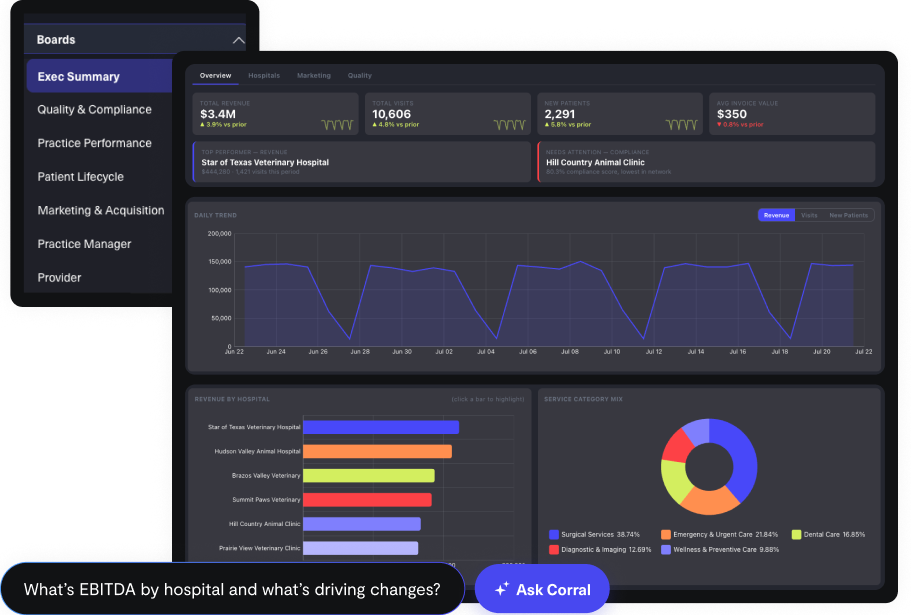
Give every role the same board, filtered to exactly what they're allowed to see.
Help your clients become data driven faster through seamless reporting and collaboration tools.
Grow your census and strengthen your bottom line with HIPAA-compliant analytics.
AI-powered analytics for dental practices and DSOs. Track production, case acceptance, patient recare, and marketing ROI.
Turn data into success with complete visibility of every consumer interaction.
Make data-driven decisions that enhance patient care and your bottom line.
HIPAA-compliant AI agents that optimize operations, marketing, and patient care across every med spa location.
AI-powered analytics for plastic surgery practices. Track consult conversion, surgeon performance, and marketing ROI.
AI agents that monitor, analyze, and optimize performance across every portfolio company.
Easily surface the data you need to increase sales and drive revenue.
Measure every hospital the same way and track compliance across your whole group.
See how AMP scaled profitability and enhanced patient care
See how CorralData & Evolve Results built ADVENT a true ROI engine
See how AMNH gained a better understanding of the ‘why’ behind their data
See how BodyLase unlocked full data visibility, enabling smarter marketing and stronger results
See how evolvetogether used AI-powered insights to shape a unified growth strategy
See how Geode Health unlocked the value of their data while protecting patient privacy
See how Engine identified and converted more high-value customers
See how AI and unified data drove revenue growth at Inspire Aesthetics
See how Lacoste boosted their e-commerce performance with AI-driven insights
See how Moon Juice used live insights to find, reach, and convert their best customers
See how Olympus uses data and AI to fuel growth
See how Options Medical Weight Loss maximized their LTV:CAC
See how Pfizer turned complex data into actionable marketing intelligence
See how Ready Set Rocket streamlined client reporting and unlocked actionable insights
See how Solo Stove measures true channel ROAS with a marketing mix model in CorralData
See how St. John Knits increased marketing efficiency by 50%
See how sweetgreen acquired new customers and built stronger relationships with their most loyal patrons
CorralData
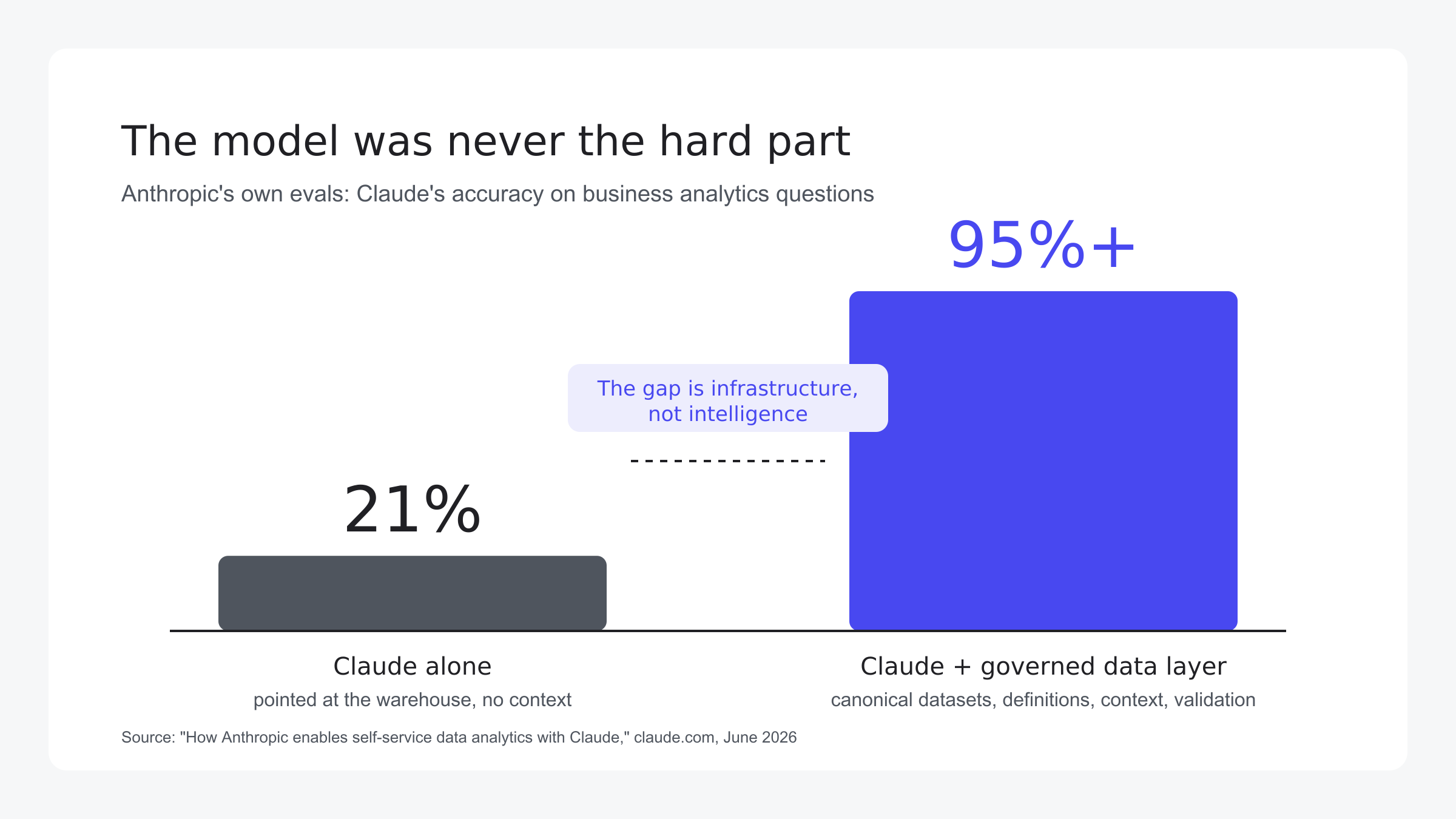
In June, Anthropic published a detailed breakdown of what agentic analytics requires: four specific layers — governed datasets, curated metric definitions, maintained AI skills, validation pipelines. That architecture is data infrastructure. Their jump from 21% accuracy to 95% is what you get when you have it.
We wrote about that finding when the article came out. The same principle holds for apps — and it answers a question that matters more: if any AI can generate a scheduling tool or a retention dashboard in a single prompt, why can’t most organizations actually deploy one?
Because generating a tool isn’t the same as shipping it. Going beyond dashboards into functional apps that run your operations — live, governed, org-wide, persistent — requires exactly what Anthropic documented: the infrastructure layer. The model builds the demo. The infrastructure is what makes it accurate and useful.
Ask Claude to build you a scheduling optimizer, a cohort LTV tracker, or a provider utilization heatmap. The output is often genuinely good — clean interface, sound logic, real interactivity. The prototype works, but it also has a structural shelf life of approximately one session. This isn’t a criticism of the model. AI was asked to generate an artifact, which it did. Everything that determines whether that artifact is useful to an organization over time — live data, access controls, persistence, encoded business logic — was never part of the prompt.
The production gap is predictable and specific:
The data goes stale immediately. The app runs against whatever was in the conversation — a CSV, a pasted table, a manually typed example. Your warehouse updated. The numbers in the app are already wrong.
There’s no permissions layer. In a single-user chat session, nobody notices. In an organization where a regional manager shouldn’t see another region’s numbers, or a coordinator shouldn’t see financials above their clearance, the absence of access controls is a compliance problem.
The app doesn’t exist tomorrow. A chat session ends. The artifact ends with it. There’s no URL, no persistent home, no way for someone who wasn’t in the session to open it next week.
The business logic isn’t encoded. “Revenue” means something specific at your company. Your rebooking rate formula excludes certain appointment types. Your utilization calculation has quirks tied to how your EMR stores provider records. The model built the app from the description it was given. It doesn’t know any of this unless someone told it, and even if they did, that context lives only in that session.
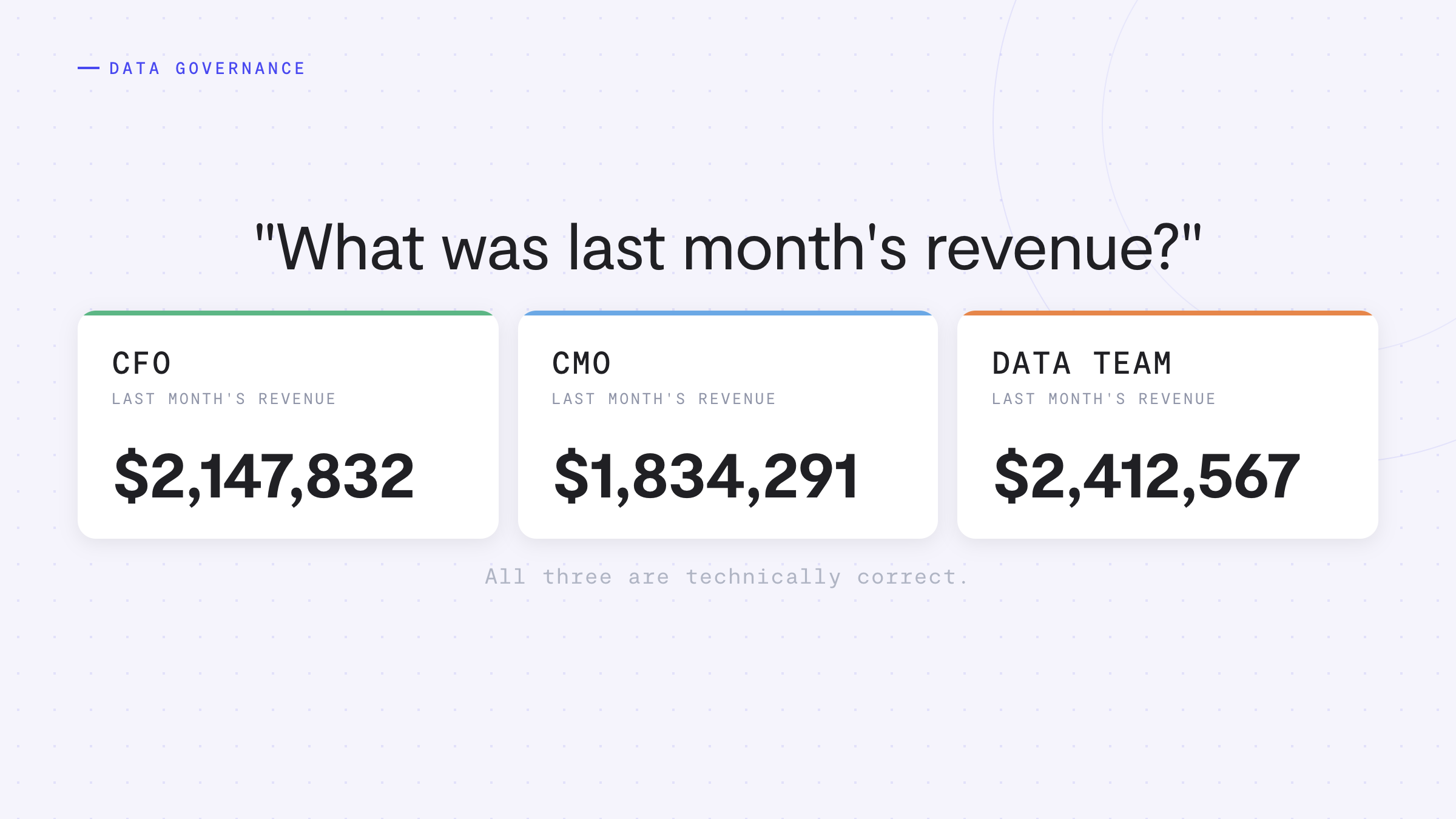
These are, in miniature, the same four failure modes Anthropic documented for analytics queries: entity ambiguity, staleness, retrieval failure, and lack of validation. The model generated something accurate at the moment of creation and increasingly wrong by default after that.
If you’ve tried to wire an AI-generated app to production infrastructure yourself, you already know this list:
A governed warehouse — not a CSV, not a snapshot, but a continuously updated single source of truth with correct data models underneath it. For healthcare, that means understanding how rebooking rate is actually calculated, how accrual revenue is recognized, how provider utilization breaks differently across EMR systems. A horizontal AI tool has no EMR models. A new entrant can build templates. Templates aren’t data models.
A read-only query bridge with access controls enforced at query time. Not a settings panel. Not a manually maintained access list. Row-level security that’s architectural — a regional manager’s query physically cannot return records outside their region, regardless of what the interface requests.
A hosting environment that isn’t someone’s chat history. The app needs a permanent home inside the tools the organization already uses. It needs to allow anyone with permissions to open it, bookmark it, and accessible six months from now.
An encoding of business logic that survives session boundaries. The definitions your organization uses — what counts as an active patient, how you calculate cost per acquisition, which service codes are included in utilization — need to live somewhere the app can read on every load, not somewhere that evaporates when the chat closes.
This is the infrastructure gap. It’s not glamorous. It’s not in the prototype. It’s everything that determines whether the app runs your business or impressed you once.
The model that builds the app can be Claude, GPT-4, or whatever ships next. That part is commoditizing fast. What doesn’t commoditize is the layer underneath.
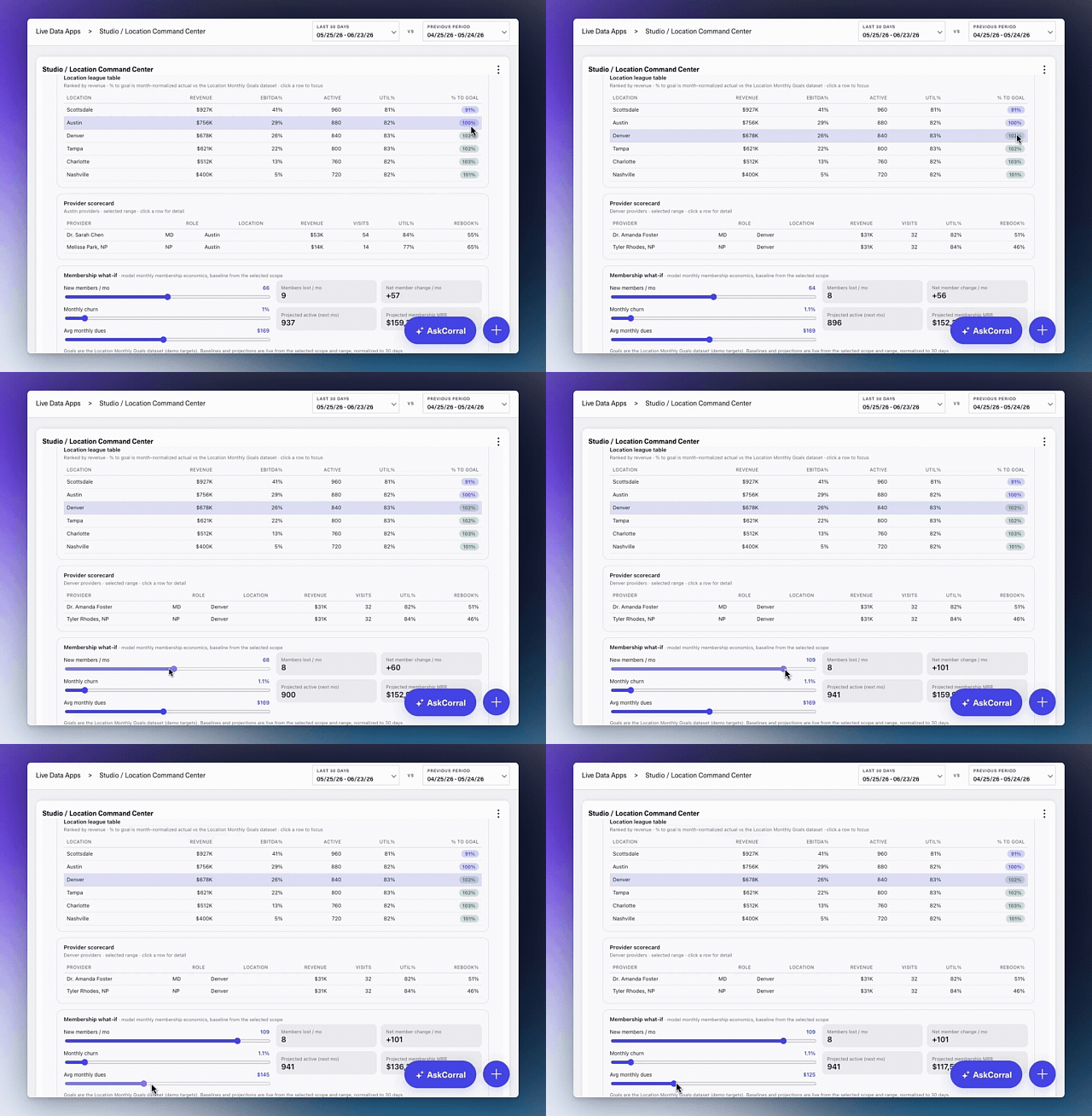
CorralData’s Data Apps run inside a purpose-built infrastructure layer: a sandboxed environment where the queries go through a read-only bridge to your governed warehouse, row-level security enforced before any data reaches the interface, the app hosted on your CorralData board with the same access controls as every other widget on it. The app inherits your data models — so when someone builds a utilization tracker, it uses your organization’s actual definition of utilization, calculated correctly for your EMR, not an approximation from the prompt.
Nothing about this is visible in the prototype. The infrastructure that makes the app’s data trustworthy over time is exactly what you don’t see when it works.
The Anthropic parallel holds: the model didn’t get smarter between 21% and 95% accuracy. The context around it made it so. The same dynamic runs through Data Apps. The AI can generate impressive output without any of this. The gap between impressive and reliable — reliable at scale, reliable over time, reliable in a regulated environment with real access controls — is filled by infrastructure.
Data Apps are what happens at the intersection of generative AI and governed data infrastructure — technology has advanced far enough that what used to be a half-year engineering project is now a prompt and an afternoon.
We’ll show you the platform live and build something from a description of what your business actually needs.
CorralData


Make your data work for you. Book a demo today to see CorralData in action.

