






 " alt="">

















Data & AI Insights

Alex Lirtsman
Use AI to effortlessly answer any business questions from all your data.
CorralData MCP brings your business data and intelligence directly into Claude and other AI assistants
Build and share custom data applications powered by your connected data.
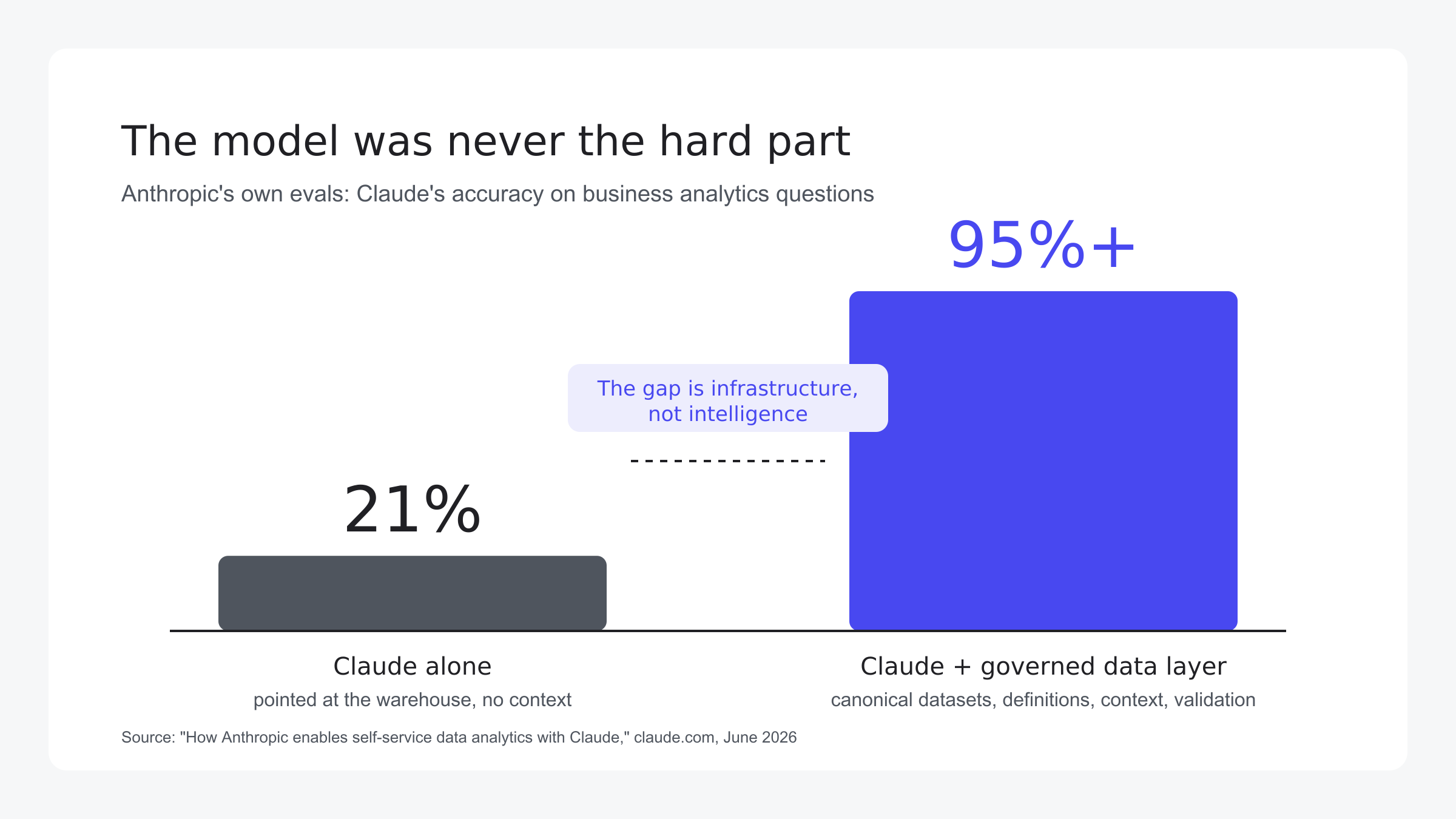
See where accuracy is won or lost across your data stack, and how a governed foundation changes the outcome.
Harness the power of AI without compromising on security.
A dedicated Technical Account Manager guides your team through it
Turn any dashboard into a clear, actionable summary in just one click
AI agents detect opportunities in your data and sync them across your platforms with our fully-managed Reverse ETL.
Sync data from 600+ sources, align KPIs, and see portfolio-wide results instantly.
Give every role the same board, filtered to exactly what they're allowed to see.
Help your clients become data driven faster through seamless reporting and collaboration tools.
Grow your census and strengthen your bottom line with HIPAA-compliant analytics.
AI-powered analytics for dental practices and DSOs. Track production, case acceptance, patient recare, and marketing ROI.
See medical, Mohs, and cosmetic performance across every clinic in one place.
Turn data into success with complete visibility of every consumer interaction.
Make data-driven decisions that enhance patient care and your bottom line.
HIPAA-compliant AI agents that optimize operations, marketing, and patient care across every med spa location.
See four-wall performance for every clinic and surgery center in one place.
AI-powered analytics for plastic surgery practices. Track consult conversion, surgeon performance, and marketing ROI.
AI agents that monitor, analyze, and optimize performance across every portfolio company.
Easily surface the data you need to increase sales and drive revenue.
Measure every hospital the same way and track compliance across your whole group.
See how AMP scaled profitability and enhanced patient care
See how CorralData & Evolve Results built ADVENT a true ROI engine
See how AMNH gained a better understanding of the ‘why’ behind their data
See how BodyLase unlocked full data visibility, enabling smarter marketing and stronger results
See how evolvetogether used AI-powered insights to shape a unified growth strategy
See how Geode Health unlocked the value of their data while protecting patient privacy
See how Engine identified and converted more high-value customers
See how AI and unified data drove revenue growth at Inspire Aesthetics
See how Lacoste boosted their e-commerce performance with AI-driven insights
See how Moon Juice used live insights to find, reach, and convert their best customers
See how Olympus uses data and AI to fuel growth
See how Options Medical Weight Loss maximized their LTV:CAC
See how Pfizer turned complex data into actionable marketing intelligence
See how Ready Set Rocket streamlined client reporting and unlocked actionable insights
See how Solo Stove measures true channel ROAS with a marketing mix model in CorralData
See how St. John Knits increased marketing efficiency by 50%
See how sweetgreen acquired new customers and built stronger relationships with their most loyal patrons

CorralData
A guide for practice owners and operators who want to make smarter decisions with their data.
Every time a patient books an appointment, a staff member clocks in, an ad runs on Instagram, or a treatment gets invoiced, your business creates data. That data is sitting somewhere — inside your scheduling software, your billing platform, your marketing tools, your payroll system.
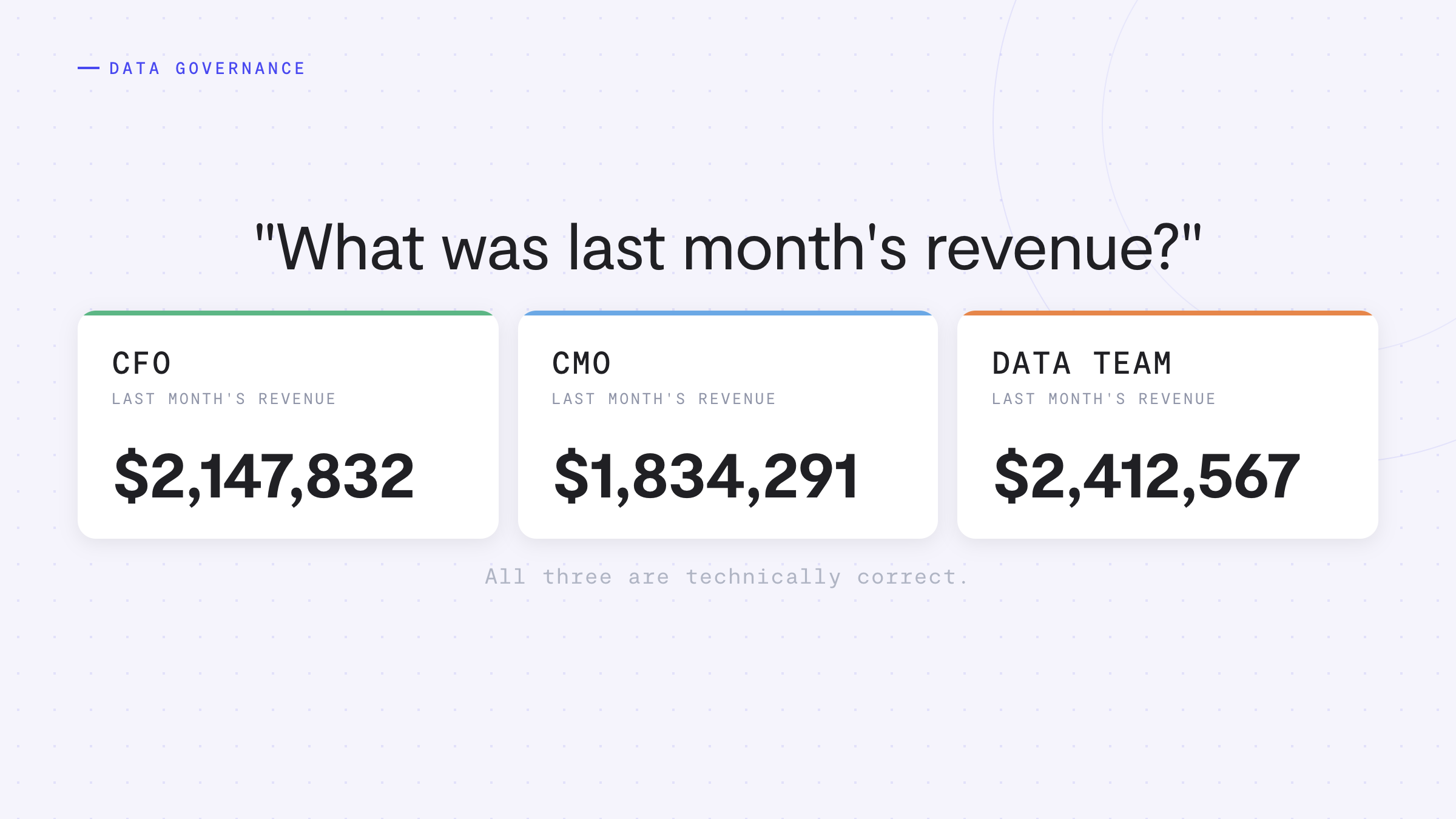
The problem is it’s scattered. And scattered data is the same as no data. You can’t see across all of it, you can’t connect the dots, and you definitely can’t act on it quickly.
This is why the concept of a data warehouse matters. And increasingly, it’s a term you’re probably hearing more often — from your EMR vendor, from consultants, maybe from a sales pitch or two. This article will help you understand what it actually means, what it takes to use one effectively, and why not all “data warehouse” offerings are created equal.
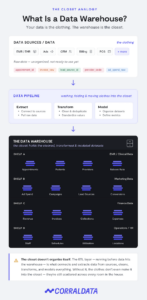
Think of a data warehouse like a central storage facility for your business’s data — a single place where information from all your different systems comes together.
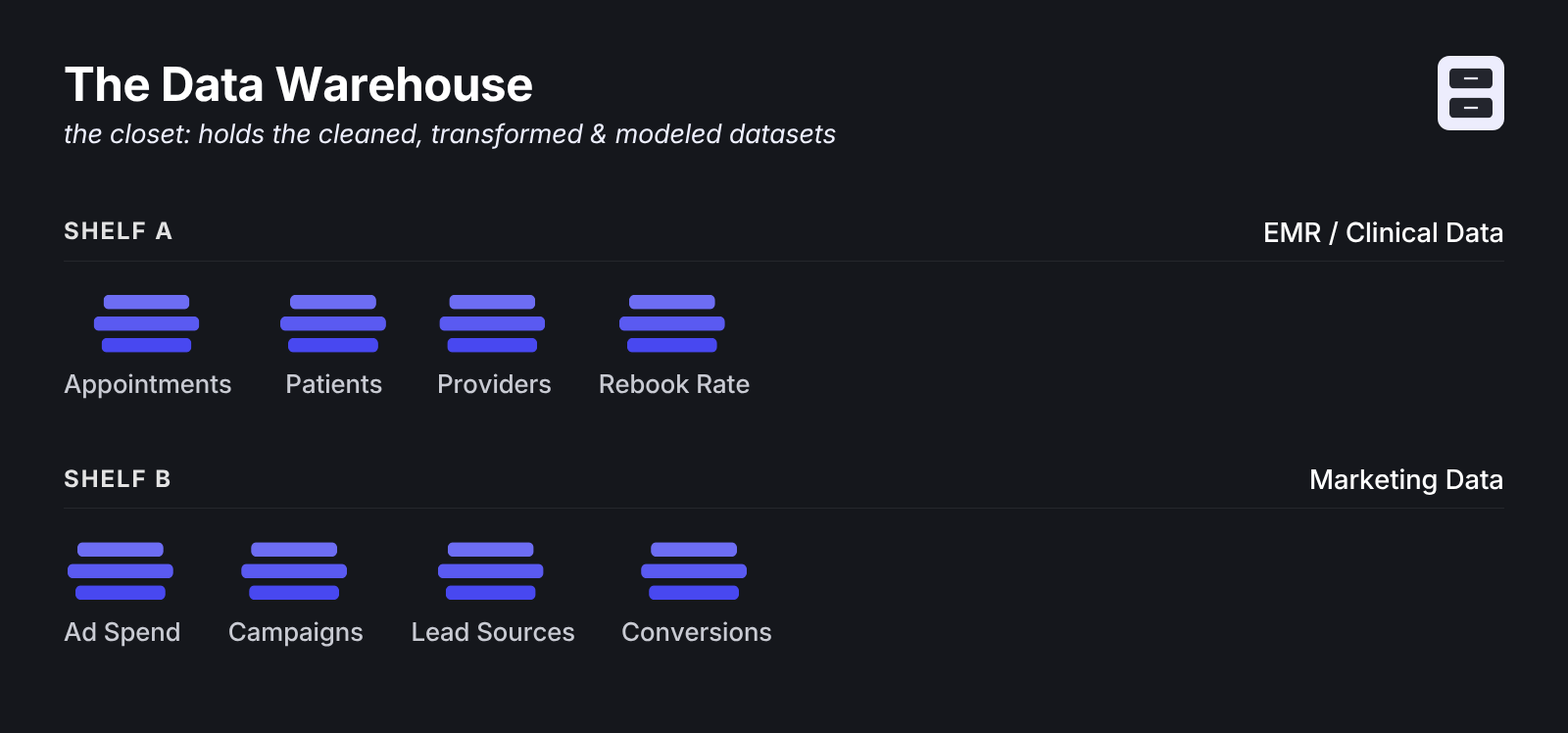
A helpful everyday analogy: imagine a well-organized wardrobe closet. Everything you own is in one place, sorted by type, season, and occasion. Your everyday work clothes are front and center. Your seasonal items are folded and accessible when the time comes. Your occasion-wear — the pieces you need less often but absolutely can’t be scrambling for when the moment arrives — is properly stored, labeled, and ready.
That’s what a data warehouse does for your business data. It brings everything together, organized, so that when you need an answer — whether it’s a routine weekly report or a high-stakes question about where your revenue is really coming from — the information is there and ready.
But here’s the critical thing most people miss: a closet is just storage. It doesn’t organize itself.
A wardrobe only works when someone:
Without all of that working together, your data warehouse is just a pile of clothes on the floor in one room instead of four.
Virtually any structured business data can live in a data warehouse:
The goal is to have one place where all of this lives together, so you can ask questions like: Which ad channel brings in patients who spend the most over their lifetime? Or: Which provider has the highest rebooking rate? These questions require data from multiple systems — and without a data warehouse, they’re nearly impossible to answer reliably.
Here’s where it gets important.
Some of the software platforms you already use — your EMR, your practice management system — have started offering data warehouse features. And on the surface, that sounds convenient. One vendor, one place.
Most of them do come with some connectors — ways to pull in data from other systems. But the real question isn’t whether they have some connectors. It’s whether they have enough to give you a truly comprehensive picture of your business.
Think back to the closet analogy. Your EMR’s data warehouse is like a closet that’s been stocked with your work clothes. It knows that world well. But your gym clothes are in a bag by the front door. Your going-out outfits are in boxes in the garage. Your seasonal items are scattered across two other rooms.
You technically own all of it. But it’s not all in one place, it’s not organized together, and getting dressed for anything beyond the routine requires running all over the house.
Your EMR knows your appointments, your clinical notes, your billing. But what about your Google Ads account? Your CRM? Your payroll platform? Your retail point-of-sale? A data warehouse that only connects deeply to one corner of your business isn’t a unified view — it’s a slightly larger silo.
There’s also the question of what happens after the data arrives. Raw data from any system isn’t automatically analysis-ready. It needs to be cleaned, standardized, and modeled before it reflects the metrics you actually care about. Someone has to do that work — and maintain it over time as systems update and business logic evolves. If your vendor isn’t handling that, you are.
Yes — absolutely. Cloud data warehouses are more accessible than ever. You can stand one up without a huge upfront investment.
But the moment you do, you’ve also signed yourself up for everything the warehouse doesn’t come with.
Back to the closet: you can absolutely install a custom closet system yourself. But the closet doesn’t fill itself. Someone still has to bring all the clothes in from the other rooms, sort through what’s worth keeping, fold and hang everything properly, establish a system that makes sense, and maintain it going forward. The closet installation was step one. The real work starts after.
The same is true for a data warehouse. Getting the storage in place is the starting line, not the finish line. The pipelines that move your data in, the transformation work that makes it usable, the modeling that turns raw numbers into reliable metrics — all of that lives outside the warehouse and requires real expertise to build and maintain.
That’s not a reason to avoid a data warehouse. It’s a reason to think carefully about who’s responsible for everything surrounding it.
When all the pieces are in place — data flowing in from all your sources, properly transformed and modeled, housed in a warehouse and connected to a visualization layer — the doors open on a different class of decision-making.
Instead of gut-feel and lagging reports, you get:
And when you add an AI layer on top of all of this? The game changes entirely. Instead of just seeing your numbers, you get recommendations. Instead of dashboards you have to interpret yourself, you get an AI agent that surfaces insights, flags anomalies, and can tell you the next best action to take. Instead of passive analytics, you get tools that can act — scheduling follow-ups, triggering campaigns, flagging at-risk patients — autonomously.
That’s not a future vision. That’s what’s possible today, when the data infrastructure underneath is actually built right.
A data warehouse is a critical piece of modern business infrastructure. But it’s one piece — and without everything else built around it, it’s just an empty closet.
When your EMR or software vendor mentions they’re offering a data warehouse, it’s a step in the right direction. But a data warehouse alone — even one with some connectors — isn’t a comprehensive analytics solution. The question to ask is: what comes with it? Who’s handling the pipelines from all your other systems? Who’s doing the transformation work? Who’s maintaining it as things change?
CorralData provides the entire stack: the data warehouse, the pipelines from 600+ sources (including your EMR, ad platforms, billing tools, and more), the modeling and transformation layer, the visualizations, and an AI layer that doesn’t just surface insights — it provides recommendations, simulates scenarios, and can take action on your behalf.
Already have a data warehouse? We connect to that too. Many of our enterprise customers bring their own warehouse — we plug into it and handle everything else: the pipelines, the transformation, the modeling, and the AI layer on top. Same outcome, whatever the starting point.
You don’t need to hire a data engineer. You don’t need to stitch together five different vendors. You just need your data working for you — we handle that.
Book a demo to see how CorralData makes your data work for you
CorralData is a HIPAA-compliant AI analytics platform connecting 600+ data sources into a single source of truth. We serve healthcare, medspas, dental groups, behavioral health organizations, plastic surgery groups, and multi-location operators who are serious about data-driven growth.
Alex Lirtsman

CorralData | In partnership with Disruptive Digital


Make your data work for you. Book a demo today to see CorralData in action.

